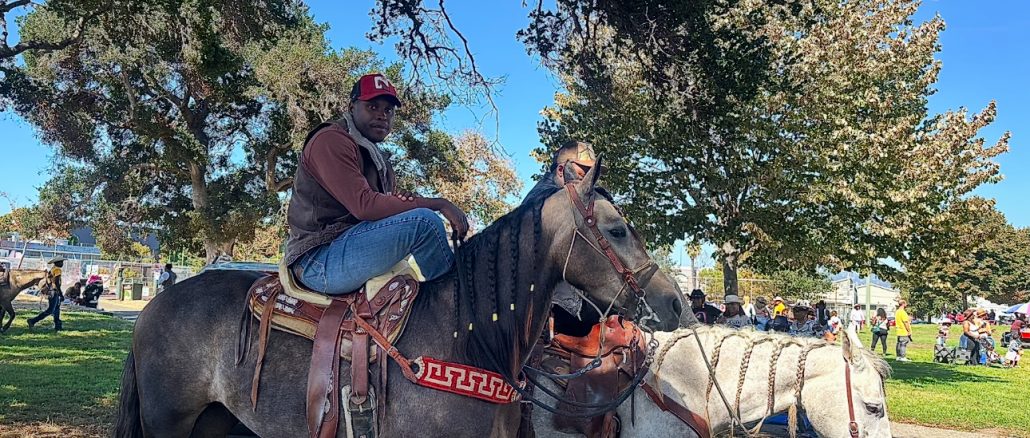
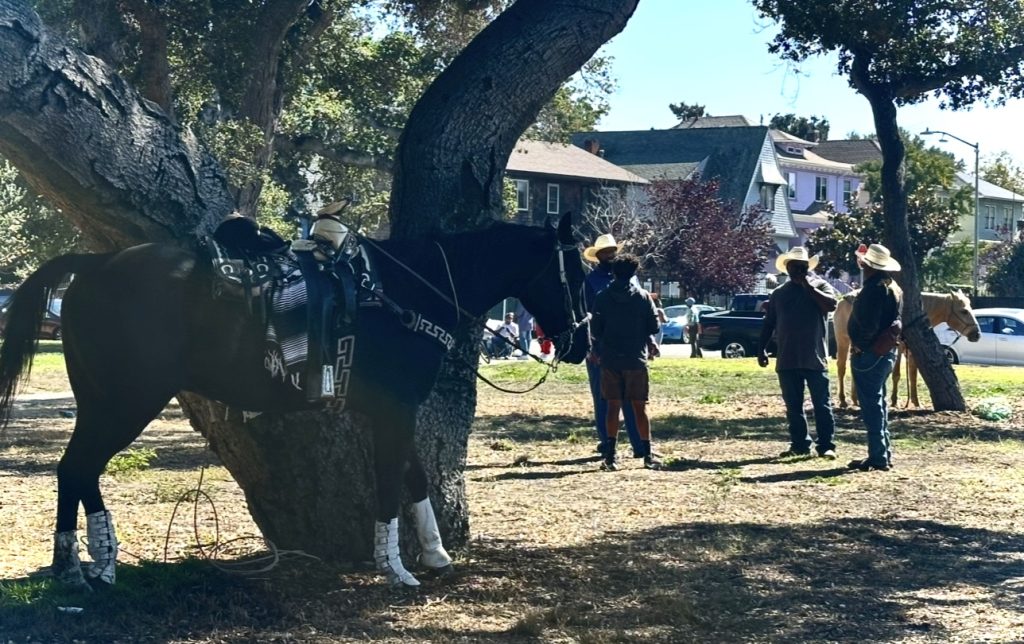
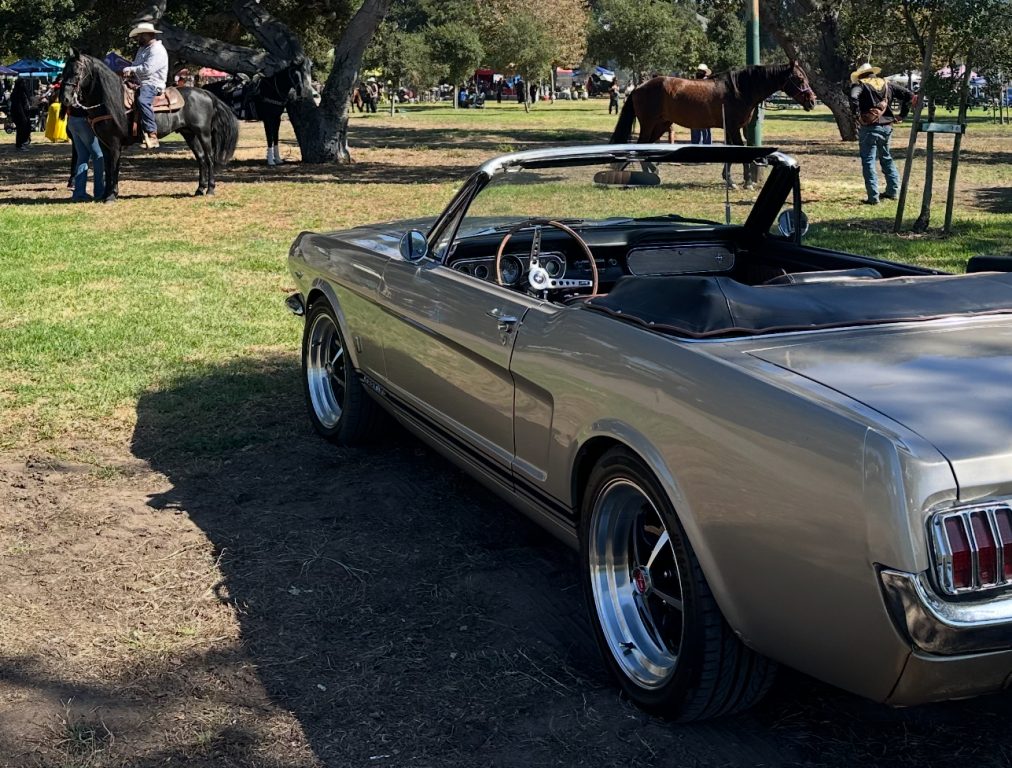
Horses and Hellcats and riders with colorful boots and hats filled DeFremery Park in West Oakland on Sat. Oct. 4 for the 51st annual Black Cowboy Parade & Festival, celebrating Oakland’s Black cowboy culture.
Visitors parked blocks away as cars, horse trailers, and motorcycles packed the park. Black cowboys sitting high on their horses greeted attendees. Some wore cowboy hats, others baseball caps. The stallions, mares, and colts dressed up too. Some wore braids in their manes or had decorated saddles.
Children lined up for horseback rides while blues music flowed from the stage, layered with the beat of African drumming played by an elder in a wide-brimmed Non la.
Vendors sold cowboy hats, incense, Black books, and African-print clothes, along with fried fish, BBQ, and Italian ice.
Black Cowboy Parade and Festival almost cancelled
From the smiles and bright sun last Saturday, one might never know the struggle and work to raise the funds to produce this year’s event. This half century old tradition, organized by the Oakland Black Cowboy Association (OBCA), almost didn’t happen this year.
A few months ago, the OBCA launched a GoFundMe to raise money to make the festival happen. They raised over $32,000 of their $55,000 goal.
The event provides an intergenerational space to ride a horse for the first time or learn more about Black Cowboy/Cowgirl culture in the West.
“It means having pride in carrying on the legacy of my ancestors and those who came before me, showing the world that we do still exist, as well as being a role model for the next generation.”
Sashae Omotade
A certified cowgirl joins the parade
Fourteen-year-old Sashae Omotade, a certified cowgirl who’s been riding since age four, said she takes pride in carrying on her ancestors’ legacy.
“It means having pride in carrying on the legacy of my ancestors and those who came before me, showing the world that we do still exist, as well as being a role model for the next generation,” Omotade said.
It wasn’t her first parade. Even though the parade route is the same, she’s now in it.
“A big difference for me is now being in the parade from before watching on the sidelines,” Omotade said.
Keeping Oakland’s Black cowboy legacy alive
Oakland holds a strong Black cowboy legacy. The Parade and Festival have existed for 51 years. It’s not uncommon to see horses at events.
Brianna Noble brought her horse, Dapper Dan, to a May 2020 Oakland protest following the murder of George Floyd. Rapper Guapdad 3000 rapped on horseback at the recent opening of Hyphy Burger.
Black men were the first ‘cowboys’
While the Western film narratives depicted the cowboy as a white man riding a horse, the first cowboys were Black. During enslavement in Texas, enslaved Black men worked by caring for the cattle and ensured they stayed with the pack. These men on the ranch were called “cowboys,” because enslaved Black men were called “boy.” By contrast, white men on horseback tending to the cattle were called “cow hands”.
Black cowboys and Black cowboy culture runs deep and holds a legacy of labor, identity, joy, and resilience.
Omotade attributes social media to the growing popularity of cowboy culture and people coming out to participate. Among all the men, women, and children wearing purple, blue, pink, and black cowboy boots, she hopes to see the community continue to grow.
The African American Museum and Library at Oakland also has a guide and collections focused on Black cowboys.

Hannah Moore is a Bay Area native ,born in Oakland California, and as a result the ‘Bay’ has very much influenced her politics, consciousness and work.
She considers herself a healer, although in the early stages of learning her craft.
She recently moved back to the Bay Area from Bahia, Brazil where she has lived for the past four years. Hannah completed her Master’s in Brazil focusing on police violence, art activism and Black masculinity.
Hannah currently works as a college and career coordinator at Alternatives in Action High School in East Oakland on 62nd Avenue.


Be the first to comment