
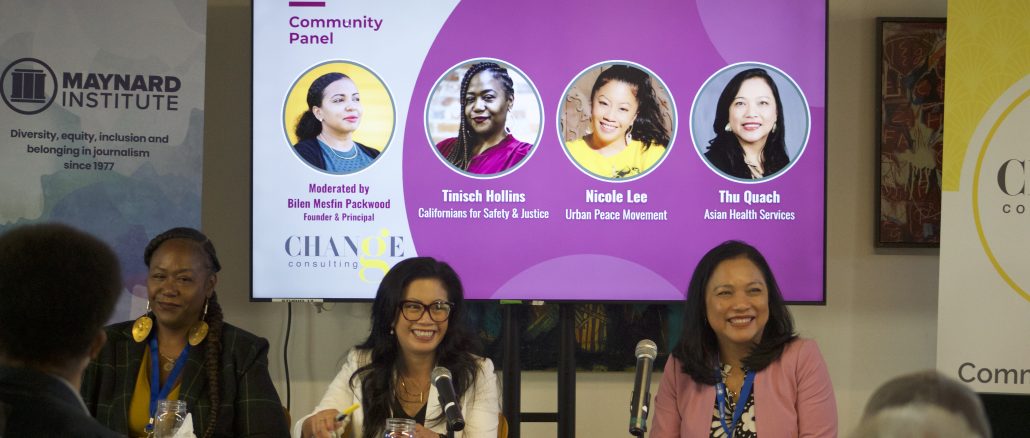
Over 70 journalists and community members gathered on September 12 at Oakstop to discuss covering crime and safety in Oakland, and news media’s responsibility in engaging with communities facing violence.
The event focused on research conducted by Baywell Health and Asian Health Services that revealed that despite increased crime reporting and public narratives about violence, this didn’t reflect the experience of many Black and Asian American residents of Oakland.
Violence is serious in Oakland, stereotypes drive tensions
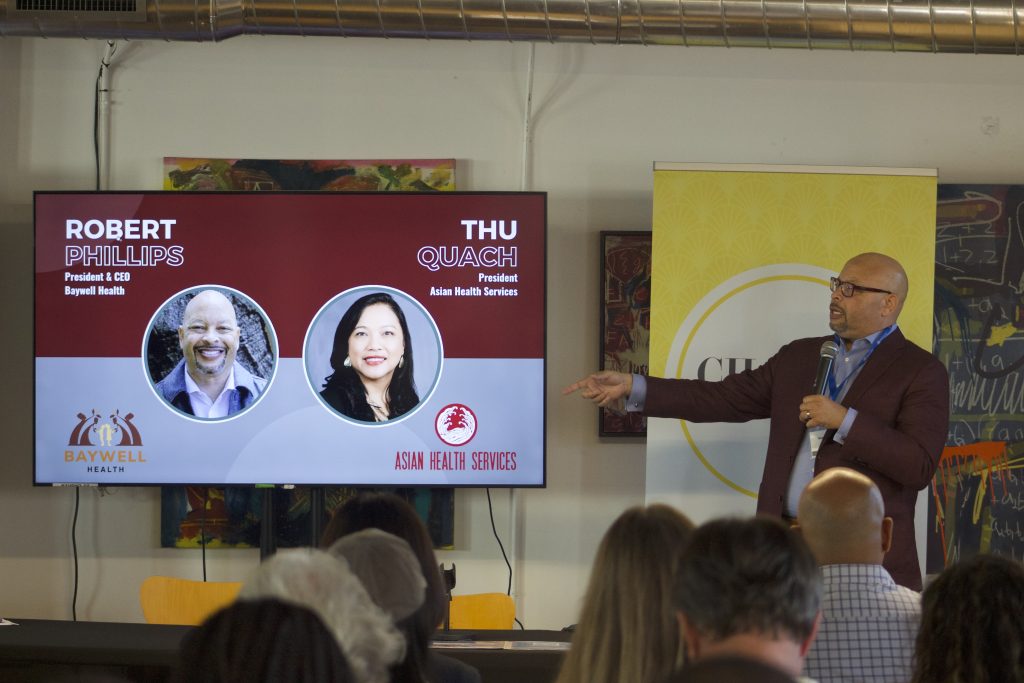
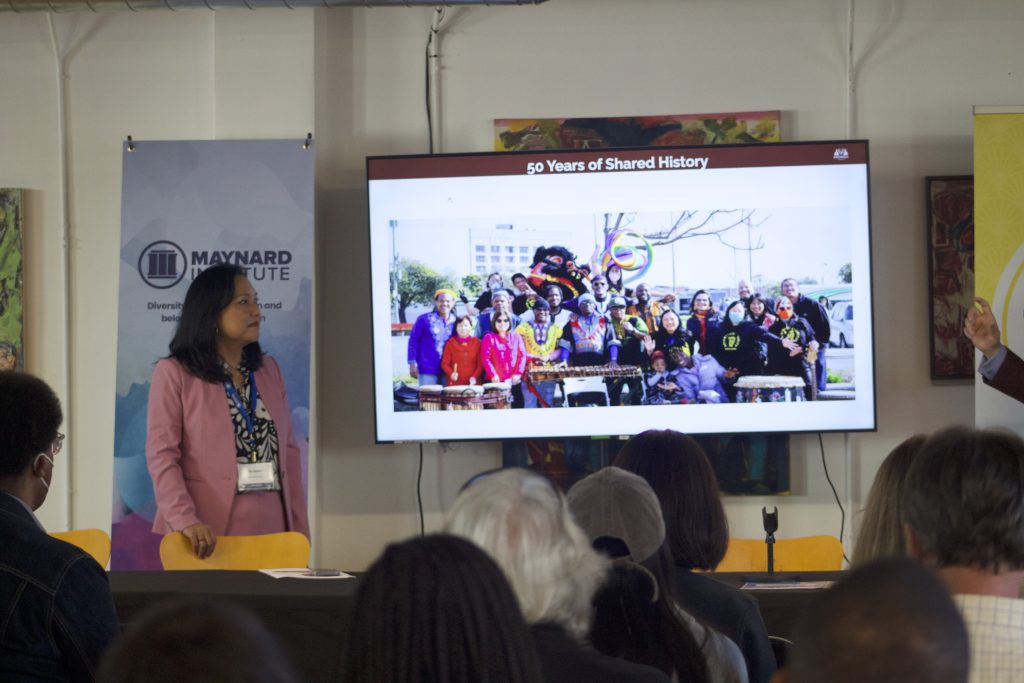
Robert Phillips, president and CEO of Baywell Health, and Thu Quach, president of Asian Health Services, shared the findings that emerged from surveys, interviews, and focus groups.
Their research found:
- 94% of respondents felt that violence in general was a “very serious problem” in Oakland
- 83% reported they felt violence against Black people was a serious problem, and
- 74% indicated that both sex trafficking and violence against Asian Americans are a severely concerning issue in Oakland.
- Sixty-nine percent also had the perception that anti-Asian hate was a concerning issue in Oakland.
Findings also revealed that community tensions were driven by media stereotypes and coverage, historical trauma, COVID-19, former President Donald Trump, and weak social ties.
It feels like it’s pushing that narrative of Black versus Asians when I feel it doesn’t really have to be that way.
Black female survey respondent
One respondent, listed as a 49-year-old Korean female, was quoted as saying “I think we have preconceived notions through how media portrays or how stereotypes are perpetuated by our network or what we hear around us.”
Another respondent, listed as “Black, 18 to 24-year-old female,” said she felt that media portrayal of Black-on-Asian crime was inflated and not representative of reality, saying “It feels like it’s pushing that narrative of Black versus Asians when I feel it doesn’t really have to be that way.”
Stereotypes, in the community, media, and entrenched in institutions, drove racial tensions between Black and Asian communities in Oakland, respondents said. Many also felt that violence against the two groups received different levels of attention and action.
Over half of all survey respondents felt that violence against Asian Americans received more attention than violence against Black residents. Panelists discussed that this perception may be two stereotypes working in conjunction: the “model minority” myth, and the myth of inherent Black criminality.
Seventy-four percent of respondents felt that public officials had taken more action in response to hate crimes against Asian American residents, while giving less attention to violence committed against Black Oaklanders.
While Black and Asian American residents recognized each other’s shared humanity and often lived in the same neighborhoods, the physical proximity did not always translate into community bonds.

Health services and social supports reduce systemic violence
Survey respondents identified four health services and social supports as critical to achieving public safety: expanding mental health services, youth job training and counseling programs, increasing non-police staff trained to respond to non-violent emergencies, and increasing investments in helping residents meet their basic needs, like stable, supportive housing and food assistance.
Community panelists discussed their personal experiences and systemic and individual instances of violence.
Investments in schools and communities reduces violence, according to Nicole Lee of the Urban Peace Movement. She spoke about the perceptions versus realities of creating community safety and referenced the 2014 ballot initiative, Prop 47, the “Safe Neighborhoods and Schools Act.” The law reclassified certain nonviolent felonies as misdemeanor crimes. A 2024 ballot initiative, Prop 36, would increase punishment for low-level drug offenses and nonviolent crimes.
This part of this story is not being told, and it leads us to these very narrow, individualistic kinds of supposed fixes that really are about creating a false sense of safety for a small group of people at the expense of most people
Nicole Lee, Urban Peace Movement
“Prop 36 is this Republican effort to repeal a hard-fought and won criminal justice reform that many of us worked on almost 10 years ago called Prop 47. Real community safety is about investment, and Prop 47, over nine years, saved $817 million that was then reinvested into schools, drug treatment programs and other programs all over the state of California, the things that actually create community safety,” Lee said. “This part of this story is not being told, and it leads us to these very narrow, individualistic kinds of supposed fixes that really are about creating a false sense of safety for a small group of people at the expense of most people.”
Tinisch Hollins of Californians for Safety and Justice said California cannot continue to rely on policing and mass incarceration to curb crime and violence and further public health.
“(California) became the model for the rest of the country on mass incarceration, and so our work is to undo that,” Hollis said. “And you have to bring the people who have been least safe into the middle of the conversation about how we create policy.” Both laws and narratives must change, she said.
Bilen Mesfin Packwood moderated the community panel which also included Quach of Asian Health Services.
Journalists discuss crime coverage, media stereotypes
Lisa Armstrong, professor of journalism at UC Berkeley, noted that media portrayal of Black Oaklanders as violent fuels anti-Black racism.
“Black Oakland residents said that they found that the media played a key role in perpetuating the stereotype that Black people in general are violent and to be feared,” Armstrong said. “They said this perception impacts racial relationships in the city and feeds into persistent anti-Black racism.”
Armstrong moderated a panel of journalists including David DeBolt of the East Bay Times, Julian Glover, an anchor with ABC7 News Bay Area, Marisa Lagos, journalist for KQED, and Roselyn Romero, reporter for The Oaklandside.
Romero and former Oakland Voices co-director Momo Chang recently co-published a story about how some Chinatown residents are rethinking public safety after the violence against Asian Americans during Covid-19.
“Black Oakland residents said that they found that the media played a key role in perpetuating the stereotype that Black people in general are violent and to be feared. They said this perception impacts racial relationships in the city and feeds into persistent anti-Black racism.”
Lisa Armstrong, professor, UC Berkeley School of Journalism
The panel discussion echoed new survey research from the Pew Research Center that found consumption of crime-related news impacted safety concerns. This impact of local news crime coverage varies across groups, stoking higher rates of fear among women, racial and ethnic minority groups and Americans who have lower incomes.
The Maynard Institute for Journalism Education co-organized the event with Baywell Health and Change Consulting. Maynard Institute co-executive director Martin G. Reynolds, and co-founder of Oakland Voices, emceed the event.
Disclosure: Oakland Voices is a program of the Maynard Institute. Oakland Voices director Rasheed Shabazz contributed reporting to this article. Read the original version of this story on the Maynard Institute’s website.


Be the first to comment