
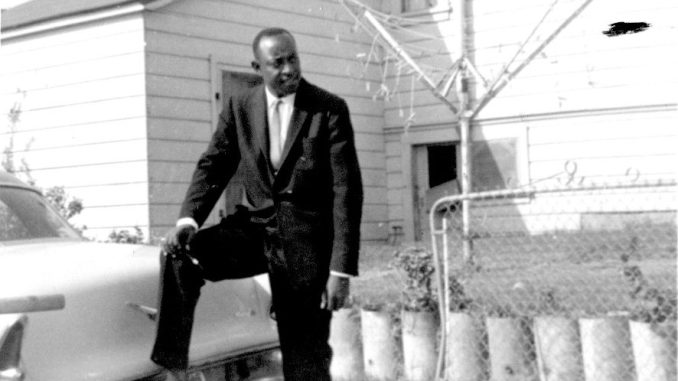
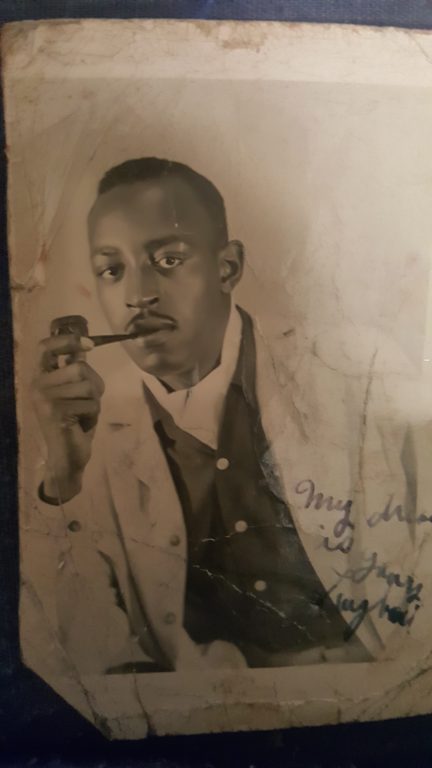
A whiff of tobacco, the curling smoke of a pipe, an olive bathed in a martini, a fresh new book with pages still stuck together–these images and feelings bring back memories of my dad.
My Dad, Laybon Jones, Sr., was an Oakland realtor, the Director of Equal Opportunity at HUD, and a leader in the Oakland Black business community during the 60s’ and 70s’. He was also a lover of words, a voracious reader, and loved the art of writing letters.
As far back as I could remember, my Dad made his way to the DeLauer’s newsstand on Broadway after church just after noon on Sundays to pick up the New York Times. After browsing in the newsstand for a bit, he would arrive home close to 1 p.m. and spread the papers out on the brown leather couch in the living room.
He would begin with the local papers, the Oakland Tribune and the San Francisco Chronicle, taking them to his big, rust-colored chair next to the large picture window adjacent to the couch. He would polish those off and then turn his attention to the Times. He began with the first page and then, section by section, he read for hours until our Sunday dinner at 5 p.m. If he had not finished reading, he would resume after his meal. When he finally finished, I, by then in my teens, had permission to leaf through to find the book reviews section and society pages.
My dad’s love of the written word was passed down to me. A long, dark brown bookcase extended between the living room and dining room, and there was not a book that Dad read that I was not allowed. No censorship in the Jones’ household. I read James Baldwin’s Go Tell It On The Mountain at age thirteen and though parts of it were over my head, I became a fan of Baldwin, just as Dad was.
Dad, Arkansas-raised, often in poverty, joined the Navy at eighteen. He returned to Little Rock, attended a HBCU, Philander Smith College, married, and became part of the Great Migration to Oakland, California in the early 50s’. He worked as a furniture mover, cannery worker, a substitute teacher, and obtained his real estate license while he and my mother raised their family. He opened a real estate broker firm and became a member and officer of the East Oakland Negro Business and Professional Men Association.
But on Sundays, Dad was in his element and routine. Church, DeLauer’s, New York Times, and Sunday dinner.



Dear Dera
I’m delighted that you’ve continued to spread the word. Your voice and others that pen the history of Oakland is so important. Its memory tells stories that would be lost if not for you and your colleagues. What? A migration? To Oakland? I thought black people fled from the cotton fields to Chicago, New York and places north of the Masons Dixon Line. Not true say you and your fellow writers. Please spread the word.
I live in New York and am collaborating with DOROT to write my family history. There’s no story of waving cotton fields and waiting for someone to free my passive ? ancestors from slavery. It’s a story that adds a further dimension to the black experience.
Good luck to you and your fellow writers.
Kathleen Wyer Lane
Formally Write Away Afrigeneas