
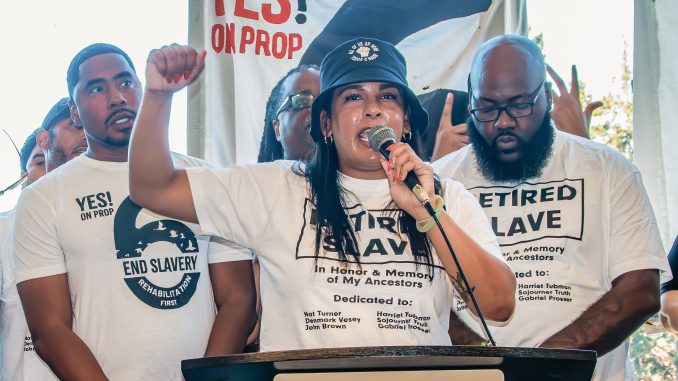
For her birthday, Dr. Tanisha Cannon invited friends and family to the Freedom and Movement Center in North Oakland. This was no typical celebration. Instead, she set up a call center to mobilize voters for Proposition 6.
If passed, Prop. 6 will amend California’s Constitution to ban involuntary servitude as punishment for a crime, effectively ending forced labor in state prisons. It would also prohibit prisons from punishing incarcerated people with involuntary work assignments and disciplining people who refuse to work. State prisons could set up voluntary programs which would take time off sentences, according to Cal Matters.
Dr. Cannon is the Managing Director of Legal Services for Prisoners with Children, a grassroots civil and human rights organization fighting for the rights of formerly-and currently-incarcerated people and their families. She believes that passing Prop 6 would expand opportunities for incarcerated and formerly incarcerated individuals.
“It’s about supporting families,” Cannon said. “When individuals aren’t penalized for not working, it helps maintain those crucial family ties, which is vital for reducing recidivism. The goal is also to ultimately increase wages.”
California’s prison population is its lowest in about three decades, according to the Public Policy Institute of California. Of about 90,000 inmates, less than half are employed in work ranging from construction, cooking, to firefighting. About one-third of incarcerated people work in roles that support daily prison operations, like cooking and cleaning.
Many are paid less than $1 per hour, and those who refuse face penalties like losing phone privileges—a vital link to their families. Additionally, the California Department of Corrections and Rehabilitation (CDCR) automatically deducts up to 50% of prison wages for victim restitution, which can total tens of thousands of dollars—a daunting amount given that a full-time prison job often pays under $20 per month.
Prop. 6 ends slave labor, supporters say
If Prop 6 passes, Assembly Bill (AB) 628 will also go into effect, requiring the CDCR to establish a voluntary work program. This companion bill was introduced to address fiscal concerns about the elimination of forced prison labor and prevent immediate wage increases for incarcerated workers immediately following Prop 6’s passage.
“This was a political compromise to get Prop. 6 on the ballot,” Cannon said. “We didn’t support this bill, but we’re planning amendments to push for better wages and working conditions in the long run.” Without forced labor, prison costs would increase. Advocates have noted this seems reminiscent of slavery. They note that if time credits were increased in exchange for work, incarcerated people would be released sooner, and this would reduce fiscal costs. In 2022, lawmakers rejected a ballot proposal to end forced prison labor due to similar concerns.

All of Us of None and Legal Services for Prisoners with Children have long advocated to eliminate slavery and involuntary servitude, and establish a living wage for incarcerated workers. The organizations are led by formerly incarcerated people on the front lines of policy advocacy and reform.
“It’s crucial that those most affected by the system lead this fight,” Cannon said. “Their testimonies humanize the issues, especially around the daily realities of women in prison—things like being stripped searched prior to leaving their job assignments or elders having to work beyond their physical ability.”
Each year, Legal Services for Prisoners with Children hosts state advocacy days, so formerly incarcerated people can advocate for themselves. They are also concerned with establishing other protections for incarcerated people, addressing climate change issues for prisons, and building on policy change initiatives.
Opposition to Prop. 6
While the state legislature unanimously voted to place Prop. 6 on the ballot, the measure could still fail due to a lack of public understanding about involuntary servitude.
In calls to California residents, Dr. Cannon often encounters harsh responses: “They do the crime, they do the time,” one person told her. Others went as far as, “Bring back the chain gang!”
These responses may be rooted in ignorance and can easily feel like racism.
There is no organized campaign against Prop. 6. However, the Howard Jarvis Taxpayers Association, the California Republican Party, and the East Bay Times oppose Prop. 6. Some believe the opposition from Republicans relates to larger opposition against efforts for Black reparations.
The 13th amendment to the U.S. Constitution eliminated slavery, but enabled an exception for those duly convicted of a crime. Involuntary servitude, slavery, is a punishment felt by incarcerated people, even for those convicted of victimless or nonviolent crimes.
Find your polling place on Alameda County’s Registrar of Voters office.



Be the first to comment