
By Brooke Anderson, Prism
This story was originally published in English at Prism.
Immigration and Customs Enforcement (ICE) has for months intensified its longstanding campaign of terror against immigrants. Now, the agency is also punishing the everyday people coming to their defense.
Masked federal agents have abducted anyone they suspect of being a migrant—from workplaces, houses, courthouses, schools, and streets. ICE has forced its way into people’s homes with battering rams, dragged a pregnant woman through the snow, taken children as young as five into custody, and killed American citizens Renee Good and Alex Pretti in Minneapolis.
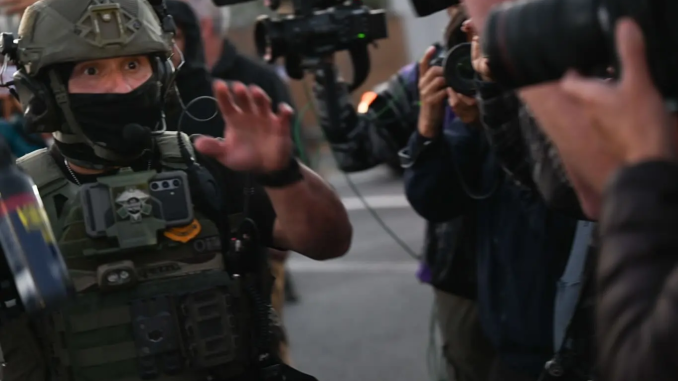
And at every step, journalists have documented the rapidly escalating state violence—often at great risk to themselves. While covering ICE’s enforcement surge in Los Angeles, TV reporter Lauren Tomasi was live on air when a Los Angeles Police Department (LAPD) officer aimed his weapon directly at Tomasi at close range, hitting her with “nonlethal ammunition.” Photographer Nick Stern required emergency surgery after LAPD shot his thigh with a plastic bullet. In Chicago, an ICE agent shot a pepper ball into the parked car of reporter Asal Rezaei, and in New York, ICE agents shoved visual journalist L. Vural Elibol, causing a head injury that required emergency services.
Ryanne Mena, who covered the ICE raids for the Southern California News Group, was shot on June 6 in the left thigh with a pepper ball bullet. The following day, she was struck in the head with a rubber bullet and the reporter next to her was hit in the head with a tear gas canister. Mena, who has asthma, had difficulty breathing and bystanders helped the reporters flush their eyes with water.
“I spent the rest of that day with a grueling headache. I threw up later that night, and two days later I was diagnosed with a concussion,” said Mena, who noted that a half year later, her brain fog is just now starting to dissipate and that she continues to experience heightened anxiety.
In Minneapolis, freelance photographer John Abernathy was surrounded and tackled by immigration agents on Jan. 15. “They set off a flash bang and then tear gas,” he explained. “I was shot twice with pepper bullets in my leg. I was then surrounded by border police and taken to the ground where they sprayed me in the face with pepper spray. My face was on fire. My eyes were on fire. I was gasping and gagging. I ended up having multiple injuries from the pepper bullets, chemical burns in my eye, and abrasions from being taken down.”
Journalists of color and immigrant reporters are especially at risk. El Salvador-born journalist and asylum-seeker Mario Guevara was arrested while covering a “No Kings” rally in Atlanta. Despite local prosecutors dropping charges, Guevara was turned over to ICE, spent over 100 days in ICE custody, and was eventually deported to El Salvador. Meanwhile, in “an explicit escalation against Black journalists,” Don Lemon and Georgia Fort were also recently arrested for covering a protest inside of a Minneapolis church where one of the pastors works for ICE.
In the chilling piece from the Los Angeles Public Press, “When your local reporter needs the same protection as a war correspondent,” editor Michelle Zenarosa detailed how her small newsroom wrestled with countless safety, ethical, and legal questions after multiple freelancers with whom the publication works were shot and arrested. Staffers—who are largely journalists of color reporting on the neighborhoods they grew up in—were also harassed and doxed. While traumatized, the entire team was resolutely committed to covering the assault on their community. Zenarosa wrote, “It took us weeks to realize we were facing the same dangers as foreign correspondents in conflict zones.”
What Zenarosa registered in the newsroom felt immediately apparent to me as a freelancer in the field.
When the media is the target
I am no newcomer to violence against journalists. For nearly two decades, I’ve photographed social movements, extensively documenting police brutality and excessive use of force against demonstrators. I’ve been thrown to the ground and arrested and repeatedly struck by batons by Bay Area law enforcement in California. I’ve also trained fellow photographers on how to stay safe while covering protests where police violence is a real risk.
Yet, in October 2025, when federal agents arrived in the Bay for an immigration enforcement surge that was later called off, I witnessed firsthand the “new normal” of ICE violence. I photographed Customs and Border Protection (CBP) agents as they recklessly drove SUVs at high speed through a picket line of religious leaders, indiscriminately fired flash bang grenades at protestors and press, and shot Pastor Jorge Bautista in the face with a pepper ball at point blank range. I’d never seen anything like the volatility and vengefulness of those CBP officers, seemingly unconstrained by any type of protocol or command. Reeling from the incident, I called my partner afterward, and all I could repeatedly utter was, “I feel like I just witnessed a terrorist attack.” My nervous system viscerally caught up to what many pundits warned: that ICE is now President Donald Trump’s private paramilitary force.

As the crackdown intensifies, news organizations and journalist associations are scrambling to establish protections for press. In Illinois, they won a preliminary injunction restricting ICE’s use of excessive force against members of the media. But the Trump administration’s blatant disregard for the law renders court orders and other legal restraints unlikely to provide much tangible help to journalists on the ground.
Given ICE’s ballooning budget and swath of new recruits, federal agents may soon be able to conduct large-scale raids in multiple municipalities at once. If that happens, many more photographers will find themselves documenting de facto federal occupations of their communities
This will be especially true if Trump follows through on his promise to invoke the Insurrection Act and deploy federal forces to U.S. cities to quell protests against the raids. As the National Immigration Law Center explains, Congress passed the Posse Comitatus Act to prohibit the U.S. military from participating in civilian policing, with the exception of an insurrection that local and state forces cannot control. So far, violence surrounding the raids has come almost entirely from federal agents. Local and state officials, far from requesting federal back up, have called for ICE to leave their communities. Weaponizing the Insurrection Act to force unpopular raids should be illegal under those conditions, but Trump may attempt it anyway.
“The Insurrection Act by itself does not suspend freedom of press or any other constitutional rights beyond the right to assemble,” said longtime civil rights and movement attorney John Viola. “However, to invoke the Insurrection Act, there must be a proclamation of insurrection, and that proclamation may contain emergency orders with specific restrictions, like a curfew. Those orders may later be challenged in court, but frontline journalists should read the specifics of that emergency order and ask themselves: How do I protect myself, and how do I push back against laws that I feel are unjust, immoral, unconscionable, or that get in the way of freedom of the press?”
While staff photographers may have the backing of their editors and publishers in navigating risk on shifting political and legal terrain, especially if they are unionized, independent and freelance photojournalists are largely on their own. So are community members who may not identify as media but who bring a camera or cellphone into the streets to document ICE activity, only to find themselves a target of federal agents—as was the case with Pretti.

With these far less protected photographers in mind, I asked journalists who have been covering the ICE raids in LA, Oakland, Chicago, and Minneapolis to share their advice on staying safe. Here’s what they said:
- Don’t take unnecessary risks
Providing the public with powerful images of rising authoritarianism—and the resistance to it—is critical work, but you need to be alive to do it. No one photograph is worth your life or health. Many of the professional journalists injured by the Trump administration’s deportation forces did everything right and were still injured. So while there is no way to totally mitigate risk, it’s important to know when to pull back so you don’t get hurt.
- Build community with other photographers
More than a press pass or any piece of personal protective equipment, it is relationships with other journalists that will keep you safe. It is other photographers, reporters, local residents, and grassroots activists who will share information about what is happening when and where, or who will take your gear or call your family if you are arrested. So introduce yourself to other media makers, follow each other on social media, and if possible, join your local union.
- Wear a press pass and carry a photo ID
Media credentials don’t confer automatic protection; they can’t stop a bullet or tear gas canister, or get you through police lines. They are also no substitute for wearing personal protective equipment, staying aware, knowing your rights, and looking out for each other. However, in some circumstances, identification may provide more access, and if you are arrested or beaten while documenting, a press pass establishes that police knew you were media. But as ICE seeks to minimize documentation of their brutality, many journalists now question whether being visibly identified as press actually reduces their risk or simply makes them a more visible target.
Staff photographers already have press passes, but many independent photographers don’t know that they can get one too. The union I belong to, Guild Freelancers, Communications Workers of America, issues press passes to members, and the National Press Photographers Association offers a similar member photo ID.
Lastly, if you get arrested, having government-issued identification (e.g. a drivers license, if you have one) can prevent delays in processing you at jail.
- Know (and exercise) your rights
In general, journalists have the legal right to document police activity, so long as we do not interfere. These protections may vary by state. For instance, in California, my union helped pass Senate Bill 98, which allows journalists (including freelancers) to enter or remain in closed spaces during protests or civil disturbances. However, a right is only a right if you can actually exercise it, and unfortunately, this right is routinely and blatantly violated by both local police forces and federal officers. If your community has a National Lawyers Guild legal support hotline number, memorize it or write it on your arm with permanent marker in case you are arrested.
- Wear protective gear
If chemical agents such as pepper spray are deployed by law enforcement, it can be helpful to have goggles, a respirator or other mask, a water bottle (for rinsing eyes), and Sudecon irritant spray decontamination wipes (for cleansing skin exposed to pepper spray or tear gas). Ear plugs can protect your hearing if police deploy flash bang grenades. Some photographers also choose to wear ballistic vests for live ammunition and helmets to protect their head if hit with a pepper spray ball, flash bang grenade canister, or “nonlethal” ammunition such as rubber bullets or pellets that have actually killed people. For more tips, NPR reporter Kat Lonsdorf posted a video of her packing list for covering ICE raids, and so did photojournalist Chris Post who directs the International Media Support group that provides safety education for journalists. Their videos include more detailed information on these items. It’s important to note that freelance journalists can apply for free protective gear through Crisis Ready Media, an organization that provides training and resources for journalist safety.
- Maintain situational awareness
It’s difficult to have a well-informed risk assessment when all you see is what’s visible through your camera’s viewfinder. It’s important to regularly pull the camera from your eye to get a 360-degree view of the scene in order to note, for example, if the energy has shifted or if more police have arrived. You should also constantly track whether you have a viable exit path if the situation escalates. In calmer moments, you can practice shooting in burst mode, or high continuous mode, without looking through the camera’s viewfinder, which will allow you to continue shooting while looking around or backing away from a scene. Another strategy is to ask a non-photographer buddy to closely shadow you and to watch your back while you shoot. This person can also film any interactions you have with police and take your gear if you’re arrested.
- Document (almost) everything
In addition to taking photos that tell the story of the raids and the community response to them, document the faces, badge numbers, and vehicles of law enforcement agents, in case you or someone else faces violence or a violation of your rights.
Mena, the California reporter who local law enforcement shot twice with nonlethal munitions, told Prism that it’s also important for journalists to document their injuries and seek immediate medical care. Due to the injuries she experienced, she was a plaintiff in a lawsuit that won a preliminary injunction in California’s Central District barring ICE and CBP from brutalizing protesters, legal observers, and members of the press.
For individual activists, freelance photographers, and staff at publications aligned with movement journalism, being intentional about what you’re not documenting is as critical as what you are documenting. In an era of increased state surveillance and repression against activists and communities of color, many photos, videos, and livestreams of protests are used to justify arrests, enhanced charges, firings, and deportations. Focus your documentation on police misconduct and the more intentionally visible parts of public demonstrations (e.g. the front of marches where people know they are being photographed).
Movement journalism as resistance
Many journalists are now seeing the assault on their rights as part of the broader rise of authoritarianism in the U.S. ushered in by the Trump administration. It’s increasingly important for journalists to understand that true safety will only come from using our privileges as media to actively advance resistance to that authoritarianism.
“Despite the repression against journalists in the U.S. right now, we still have a lot of privilege,” said freelance photographer Steel Brooks, who covered protests at ICE’s Broadview detention center near Chicago last year. “What’s happening to us is nothing compared to what’s happening to people who are the enforcement targets of ICE, to people being kidnapped and deported, to the journalists from Gaza and all over the world who have been killed.”
While most staff photographers on the clock cannot directly align themselves with protesters in the streets, there’s an increasing number of independent photographers who see their work as movement journalism, which is rooted in social movements, prioritizes storytelling by directly impacted people, and brings rigorous truth-telling and power analysis to reporting in service of liberation.
Longtime movement photographer Rae Breaux was in the streets every day documenting ICE when the raids began in LA in June. She said there were times when she was torn between documenting police violence and responding to police violence.
“I have some street medic training for actions, so half the time that I’d be trying to document, I’d get pulled into something more urgent,” Breaux said. “The movement often wants photographers to get the shots, but we also need to be training photographers in skills like deescalation and how to navigate these intense situations.”
Another California-based freelance photojournalist, David Bacon, has spent decades covering the struggles of migrant workers. He was photographing at Coast Guard Island in Oakland, when CBP unleashed violence against protesters in October.
“Trump and the Border Patrol want to put us into this box where all we do is react to them, but our participation as movement photographers means that we don’t just want to document what is being done to us and turn ourselves into victims,” Bacon said. “We must also document who we are as a people, how we are organizing, and use photographs to tell that story.”
As photographers, we inherit a long tradition of journalists and storytellers who have wielded their cameras to not only expose state violence, but to also uplift collective care, mutual aid, and deep solidarity. Our right and ability to do this work is now under intense assault. But as Mena said, “This won’t stop me.”
Prism is an independent and nonprofit newsroom led by journalists of color. We report from the ground up and at the intersections of injustice.


Be the first to comment