

Oakland children live in neighborhoods vulnerable to lead poisoning. Despite receiving millions from a legal settlement six years ago, action from the City of Oakland is still lagging.
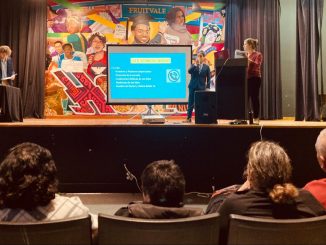
El Tímpano, an Oakland-based news outlet focused on Latino and Mayan immigrants, hosted “Toxic Inaction: Addressing Oakland’s Lead Crisis” on February 20 at Oakstop Broadway. The event revealed that Oakland has yet to address widespread lead hazards, leaving lower income and racially diverse neighborhoods in the Town at risk.
Speakers emphasized that persistent public pressure is key to holding the government accountable to take action and communities accessing available resources.
The community meeting featured a stacked panel of thought leaders and professionals in civic health. Speakers included Marybelle Nzegwu Tobias, founder of the Bay Area consulting firm Environmental/Justice Solutions. Tobias authored a racial equity analysis in 2021 focused on eliminating lead paint hazards in Oakland and Alameda County. Findings note that neighborhoods most burdened by lead poisoning in Alameda County are in Oakland.
Other panelists included former director of the Alameda Healthy Homes Department, Larry Brooks, and Oakland’s Assistant City Administrator, LaTonda Simmons. El Tímpano’s Senior Health Equity Reporter and Editor Jasmine Aguilera moderated the discussion.

Panelists responded to audience members and discussed the slow or sometimes non-apparent action on the part of the City to resolve issues of lead poisoning. El Tímpano’s reported issues included staffing issues, turnover, and strained relationships between City and County officials. While the City also pointed to a lack of budget to tackle the issues, an investigation found that a large sum was awarded to the City in 2022. Paint manufacturers settled with Oakland over the lead issue in 2019 to the tune of nearly $5 million. That sum had yet to be spent as of August 2024.
We’ve had a pretty good relationship with the Housing and Urban Development regardless of if there was a Democratic or Republican in the White House,. What has made the situation worse now … is the situation in Washington, D.C..
The new federal administration is one of the obstacles, as city officials experience new challenges accessing federal funds.
“We’ve had a pretty good relationship with the Housing and Urban Development regardless of if there was a Democratic or Republican in the White House,” Brooks said, before expressing unusual difficulties that came with the second Trump administration. The obstructions were likely a consequence of President Donald Trump’s rollbacks to funding and staff across several federal departments. “What has made the situation worse now … is the situation in Washington, D.C.. Right now, I’m not even able to talk to my partners there in HUD, people that I’ve got to work with over the years.”
Potential Solutions
Panelists encouraged those Oakland immigrants concerned about changes to Immigration and Customs Enforcement protocols to exercise anonymous correspondence to see their needs met. Letters, and collaborations with public figures and activists dedicated to the work were endorsed. These measures serve not only as harm-reduction measures for immigrants, but as tools to buffer renters against retaliation from landlords, regardless of their migration status.
Tobias covered key takeaways and recommendations from her report, Racial Equity Impact Analysis: Eliminating Lead Paint Hazards in Oakland & Alameda County. Proposed actions included an overall increase in lead testing and more accessible testing options for Town residents. Other recommendations included imposing fees for landlords, and leveraging the funds to conduct lead abatement procedures. Panelists also discussed leaning into philanthropic sources.
Above all, the Assistant City Administrator Simmons encouraged community members to stay vigilant and vocal, by complaining as much as necessary until our needs are met.
“The complaint isn’t just about calling out the momentum and the pace of work; we acknowledge that government is slow… but with the complaint comes money and resources,” Simmons said. “And while we may not be able to capture the attention of our federal partners, our state is still a player in the game. And we should insist that they be part of this narrative, they have regulations, and that they put money towards being able to support a sustainable response to this kind of work.”
Pulitzer Center’s StoryReach US Fellowship supported the event, the first in a developing series of community discussions hosted by El Tímpano. Consistent with El Tímpano’s mission, the event was oriented to Oakland’s Latin population, and featured live translation services for non-English speakers. El Tímpano is on track to hold several more town hall-style speaking engagements with panelists in Oakland in the future. To check in on the next panel or get involved, go to El Tímpano’s official website.
Editor’s Note: Oakland Voices has previously partnered with El Tímpano.

Kwajo is a second-generation Haitian living in Ghost Town. He was trained in the historical materialist analyses of the Black Panther Party, and delivers his writings through Pan-Afrikan and scientific socialist lenses. Kwajo is the head of a small, Oakland-based media house, The Black Male Journal, where he produces articles, reports, and short form video content centered on Black male wellness and justice advocacy.



Be the first to comment