“I have a passion for juvenile justice,” says Michael Gibson, Program Director of EMS Corps.
Photo by Sabirah Mustafa Oakland Voices 2012
By Sabirah Mustafa
“Street stars” is how Michael Gibson, 37, and his friends used to describe the drug dealers in his childhood neighborhood of 89th Avenue and MacArthur. His friends had similar experiences of “not having enough,” Gibson explains, and they glamorized the street stars lifestyle. “We thought that was the way to be.”
Gibson, a baby-faced six footer with large tattoos across his arms, settles his sturdy frame in his office chair at Alameda County Public Health, where he has served for the past three and a half years as the Program Director of Emergency Medical Services (EMS) Corps – a youth development, mentorship and training program in medical healthcare.
He has also worked as a case manager at Youth Uprising – an East Oakland organization serving at-risk youth – where he created and lead a group for young men to discuss spirituality, violence-prevention, and mentorship.
Gibson’s dedication to guiding young people away from the street and towards more productive lives comes from hard lessons he learned as a young man, trying to be one of those street stars.
The second oldest of four siblings, Gibson grew up in Deep East Oakland during the 80’s crack epidemic. His parents struggled with their own addictions. That’s where he first got exposed to drugs and dealers – they were both a constant presence in the house.
Gibson was raised by his grandmother who worked long hours as an in-home care nurse. With only her limited income to support him and his brothers, Gibson says he felt an obligation at a young age to contribute to the household financially.
So he did what he knew. There was the glossy facade of disposable income, expensive clothes, cars, and sneakers – the life of a drug dealer. There was practically an open invitation to that non-exclusive club. To join, all you needed was a gun.
As a youth, he recalls a popular neighborhood drug dealer casually asking him what came to be a life-defining question: “What do you want?” Gibson earnestly replied, “I want what you have – money, power, and respect.”
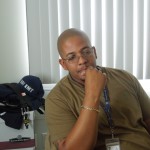
Gibson contemplates his former life as a “street star.”
Photo by Sabirah Mustafa Oakland Voices 2012.
Gibson and his brothers were often left unsupervised, which allowed him to keep his drug selling a dark secret from his grandmother. Meanwhile, his younger brothers watched and admired his hustler’s lifestyle. “They emulated me growing up,” he recalls, solemnly staring at his folded hands. “They followed the same path.”
That path included multiple arrests – mostly for drug offenses – and a revolving door of incarcerations in Juvenile Hall. In 1991, At 16, Gibson was arrested for strong arm robbery, possession of illegal firearms and attempted murder of an officer. He was charged as a juvenile and sentenced to spend eight and a half years at the California Youth Authority (CYA), formally called the Department of Justice. (A plea deal later established that Gibson wasn’t the shooter and his sentence was reduced by 5 years.)
The CYA was a “prison for youth,” he says. Looking back, though, he feels he “was lucky. Now they’re trying to charge juveniles as adults and send them to prison adult offenders.”
Any luck Gibson had ran out during his incarceration at CYA, when he participated in a riot in which an officer was assaulted. He was punished with nearly a year in solitary confinement. “Life wasn’t easy in solitary,” Gibson admits.
He got some reprieve when CYA offered him the African American Male Transition Program, which provides personal transformation and life skills for young offenders. AAMTP was created by Wade Nobles – an academic noted for his work in African psychology – and it emphasizes manhood development and spirituality.
The program’s principles were designed to develop inner strengths through self-purpose, education, and conflict resolution. There were also African-American male community leaders and role models who provided living examples of excellence.
But as much as he wanted out of solitary, Gibson was skeptical of the program. “I wasn’t ready,” he said of the personal commitment and responsibility that AAMTP required of him. “I only signed up to get my time cut.”
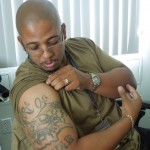
Sun Tzu’s, “The Art of War”, tattooed on Gibson’s arm, reveals Tzu’s profound influence.
Photo by Sabirah Mustafa Oakland Voices 2012
He got that, and much more. As a result of Gibson’s participation in the program, his time in solitary confinement was reduced. A man he calls Coach – an elder at the Omega Boys Club and an AAMTP mentor – introduced Gibson to Sun Tzu’s iconic book of military strategies, The Art of War. Gibson says that book shifted his outlook, made him more open to AAMTP’s principles, and helped him endure his remaining time at CYA.
He earned his GED while he was locked up, and at age 19, the eighth-grade dropout was finally released.
Back in his old neighborhood and on parole, he had to make wiser choices than he had when he was a street star delinquent. Soon after his return home, his female cousin was brutally assaulted. Instead of following his male relatives on a revenge mission, Gibson held back and called one of his mentors for guidance. “I didn’t want to be in the life anymore,” he says.
That intervention shaped Gibson’s decision to attend Laney College and stay out of trouble. He eventually received a scholarship from the Omega Boy’s Club to attend Morehouse College where he graduated in 2006 with a degree in English and Drama.
Reflecting on his life, Gibson speaks with the solemn conviction of a man who has been to the edge and turned his life around. “Being in jail was a blessing and a curse. I didn’t have the frame of mind to function in the community without destroying it.”
However, Gibson adds, “Youth Authority didn’t change me. Community-based organizations did.” He credits them for “facilitating and coordinating my personal transformation and knowledge of self. I was fortunate, because I was ready for change. I had these experiences in order to do things better.”
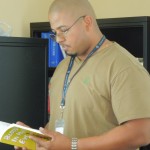
Gibson browses “Blood in My Eye,” by prison revolutionary, George Jackson. A powerful book he read while incarcerated.
Photo by Sabirah Mustafa Oakland Voices 2012
Having spent 17 years working in the criminal justice system and working as a youth counselor, Gibson heaves a deep sigh as he describes the uphill battle juveniles face today in courts, behind bars, and on parole. “They’re different laws now. They’re stricter, and the punishment is harsher.”
Glancing over at a thick, yellow and black LSAT study guide near his chair, he talks about his plans to go to law school to study “criminal or civil law in order to be a better advocate for the community.”
AAMTP molded Gibson’s ceaseless commitment to community service. The program taught him to appreciate his black community and culture, and to respect himself as an African American man – values he says teachers and colleagues in the past had encouraged him to discard.
Like Sankofa – the mythical bird in West African culture that symbolizes going back to retrieve things lost in order to move forward – Gibson also had to go back and reconnect, while he was incarcerated, with his own history. He regularly draws on his past struggles to help him improve his life, and those of others.
Through the African American Male Transition Program, Gibson had a chance to explore spirituality. After his release, he continued to study the religious traditions of Nigeria’s Yoruba culture. In 2007, he was initiated into the Yoruba priesthood.
Closer to home, Gibson’s growth as a mentor and spiritual healer has taken him full circle.
Married for six years, he has a five year old son, Michael III. “He came out during the Ifa initiation,” Gibson explains, referring to one of several ceremonies he did on his path to the priesthood. “We call him Adeneken, meaning ‘next to wear the crown.’”