
Margaret Gordon has spent decades fighting pollution in West Oakland.
Now, the longtime environmental justice advocate says residents are facing another challenge.
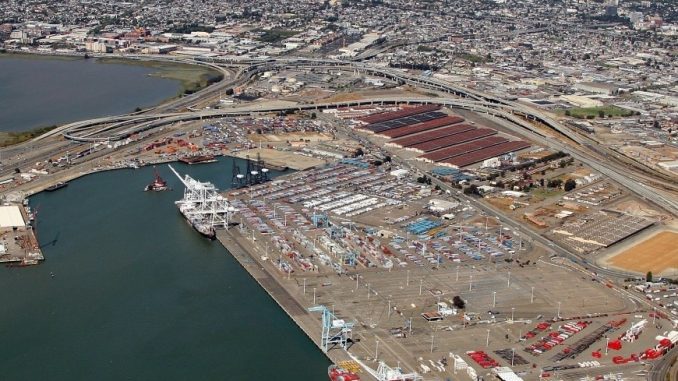
On June 4, the Trump administration announced plans for $75 million in federal defense funding for a long-delayed coal export terminal planned at the former Oakland Army Base.
The funding would bolster the U.S. coal industry and help advance the Oakland Bulk and Oversized Terminal, which supporters say the project could create jobs and strengthen export capacity.
Opponents say it could worsen air pollution in communities already burdened by some of the region’s highest exposure to diesel emissions and particulate matter.
“12 million tons of clean, beautiful coal per year”
Federal officials described the project as part of a national strategy to strengthen domestic energy production and export capacity. The administration announced nearly $700 million for coal-related projects across the country, including the Oakland facility.
“By summer 2028, over 12 million tons of clean, beautiful coal per year will be shipped to countries all around the world,” President Donald Trump said at a press conference.
U.S. Department of Energy Secretary Chris Wright said the investment would help strengthen critical infrastructure and support jobs tied to energy production and global exports to advance “American energy dominance.”
Supporters of the terminal have long argued the project would create construction jobs, generate economic activity, and expand trade opportunities. The West Gateway project would increase the terminal’s capacity to handle 10 million tons annually, according to the Energy Department, with exports headed to Pacific allies in Asian countries.
The former army base opened in 1941 and closed in 1999.
West Oakland burdened by environmental justice
But opponents say the costs could fall disproportionately on residents living near rail corridors and industrial facilities.
West Oakland has long struggled with the cumulative effects of truck traffic, port operations, rail activity and industrial emissions.
Those concerns led to the neighborhood being selected as a priority-community for targeted air-quality interventions under Assembly Bill 617. The 2017 state law seeks to reduce pollution exposure in communities disproportionately impacted by poor air quality. The law established community air monitoring, emissions reduction planning and stronger enforcement tools aimed at protecting public health. The law also created the Community Air Protection Program (CAPP).
AB 617 led to West Oakland’s Community Emissions Reduction Program, a community-driven effort that identified diesel pollution, freight activity, and industrial emissions as major health concerns.The West is part of three Bay Area communities activists referred to as the “Toxic Triangle.”
Gordon called the plan “unconscionable” since the California Air Resources Board and the Bay Area Air Quality Management District have spent millions to reduce emissions under AB 617 to support residents “Owning Our Air” with the West Oakland Community Action Plan.
‘No Coal in Oakland’
In April, the No Coal in Oakland campaign, along with dozens of community, labor, environmental and faith organizations, submitted an open letter urging the Bay Area Air District to use its permitting authority to prevent increased pollution from coal transport through the proposed terminal.
Fine particulate matter, known as PM2.5, can enter the lungs and bloodstream and has been linked to asthma, cardiovascular disease, stroke and premature death.
More than 1,000 people and 45 organizations signed the letter, according to the campaign.
The campaign maintains a website with its losses and victories, and numerous resources.
The coalition cited a 2024 study in Environmental Research which examined coal trains in the Bay Area. Researchers found that coal transport on uncovered railcars could increase concentrations of fine particulate matter, known as PM2.5. Railcars were associated with sickness, including elevated risks of asthma, cardiovascular disease, stroke, as well as premature death. In the catchment area near the West Oakland railways, the researchers found Black and Latino residents experienced a higher burden of the negative effects of coal shipping than white residents.
The findings, according to the study authors, “provide a microcosm of what might be expected globally given the multiple millions that are exposed by the common traverse of coal trains.”
A decade of conflict over coal
In 2013, Oakland granted developer Phil Tagami permission to build a $250 million terminal on the terminal on that land.
The terminal has been the subject of extensive litigation. The No on Coal campaign pushed the City of Oakland to block coal shipments in 2016. The city adopted an ordinance prohibiting the storage and handling of coal and petroleum coke, and applied the restrictions to the proposed site.
Coal terminal developer Phil Tagami sued the City of Oakland after the City Council voted to ban coal in Oakland. The federal lawsuit argued that the city breached its contract with the developer, the Oaklandside reported.
Although courts largely sided with developers in litigation against Oakland, opponents are now focused on the Bay Area Air District, which retains authority over air permits and emissions controls.The district could impose permit conditions governing emissions controls, monitoring requirements, and other safeguards if the project proceeds. No Coal in Oakland’s April 2026 letter specifically urged regulators to require stringent emissions limits, comprehensive monitoring, covered rail cars, and strict enforcement measures.
“Yes, we do have disparities in economic development and people have the right to a job to sustain themselves and their families,” said Gordon, co-founder of the West Oakland Environmental Indicators Project. “But the coal industry harms workers, the land and the environment. They need to take those impacts and others into consideration.”




Be the first to comment