Book Excerpt: On Loop: Black Sonic Politics in Oakland
“Oakland’s funk culture didn’t just slap. It slapped back.”
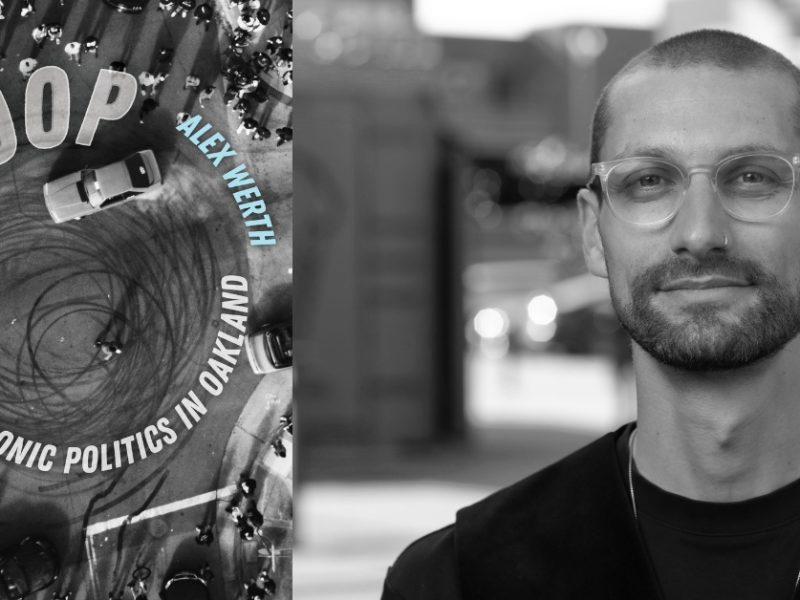
Alex Werth is writer, researcher, and DJ. His book, “On Loop: Black Sonic Politics in Oakland,” explores how struggles over Black sound have shaped Oakland’s culture, politics, and geography.
Oakland has a sound. It’s sparse, spacious, intense, like the city. The sickness and the cure, it vibrates with tension but moves bodies to release. Low in tone, high in tempo, it’s like a temple erected to the gods of “the deep.”
“Slow down / you know you can’t catch me,” raps Clyde Carson of the Team over driving 808 claps. “I move too fast on the gas / don’t chase me.” Built from propulsive bass lines, big drums, and lyrics that express the power of, well, expression more than semantic meaning (“yadadamean?”), it’s made to deliver maximum feeling with minimum resources.
In the map of Black American dance music, Chicago has house. Detroit has techno. And Oakland has “slaps”
Alex Werth
In the map of Black American dance music, Chicago has house. Detroit has techno. And Oakland has “slaps”—a signature style of party rap that’s identified by its somatic and emotional impact (as in: “that song hit me!”) more than its musical form. There’s no section labeled “slaps” in the record store. Just a loose collection of tracks—created by rappers, singers, and producers from around the San Francisco Bay Area—with the power to make people mob to the boulevard or dance floor.
In both name and sound, slaps harken back to the slap-bass style developed by Larry Graham, the bassist for Sly and the Family Stone. Born in Beaumont, Texas, but raised in Oakland, Graham got his start gigging with his mother Dell, a singer and pianist, and Ruben Kerr, a drummer, as the Dell Graham Trio. Originally the guitarist, he was tasked with providing the smooth melodies typical of early 1960s soul. But he soon discovered the power of “the bottom” during a stint at one of their regular venues, where there was an organ on stage. Still on guitar, he learned to work the bass pedals with his feet, giving the trio a more well-rounded sound—until the organ broke down. In need of a substitute, he rented a bass guitar to shore up the low end. Then, need struck again. Dell decided to economize and drop the drummer. Graham, just 15, started to thump and snap the strings of his bass to mimic the rhythmic conversation, now missing, between the kick and the snare.
“I didn’t think I was developing anything new,” he recalled. “It was just out of necessity. Just trying to do the gig right, make it sound good and feel good.” Like I said: maximum feeling, minimum resources.

Heard on records like Sly and the Family Stone’s “Thank You (Falettinme Be Mice Elf Agin)” (1969) and Graham Central Station’s “The Jam” (1975), this technique infused the emerging sound of funk music with a fun, in-your-face, and forcefully danceable West Coast vibe. The impact was indelible. Organizing songs around the bass line instead of the melody, Graham set the tone for the bottom-heavy sound of the Bay Area’s Hyphy Movement and LA’s gangster rap. For decades to come, East Bay hip-hop artists like Digital Underground excavated records from the 1960s and ’70s to give their songs what music historian and radio DJ Rickey Vincent calls “that slap.”
But Oakland’s funk culture didn’t just slap. It slapped back.
Alex Werth
But Oakland’s funk culture didn’t just slap. It slapped back. In the late 1960s, young Black migrants—who, like Graham, moved out from the U.S. South and Southwest during the Second Great Migration—led a sonic and political attack against the city’s homegrown regime of Jim Crow. Since 1966, when residents Huey Newton and Bobby Seale formed the Black Panther Party for Self-Defense (BPP), Oakland has become inseparable from the popular imagination of Black Power. Graham’s sound might have resonated with the energy of the revolution, and vice versa, but it’s the images of the 1960s and ’70s—the leather jackets, naturals, and berets, the fists, balled and raised—that have come, ironically, to memorialize “the movement.”
So, in 2016, it seemed as though every cultural organization in Oakland mounted a visual art show to commemorate the BPP’s golden anniversary. The most notable of these events, “All Power to the People: Black Panthers at 50,” took place at the Oakland Museum of California (OMCA). A monument to architectural modernism, the OMCA emerges, almost geologically, from the civic center on the south side of Lake Merritt. It sits between the Alameda County Court House, where Newton was once imprisoned and tried, and the Oakland Auditorium, where, in 1968, H. Rap Brown and Stokely Carmichael rallied 5,000 supporters to call for his release.
These and other scenes from Oakland’s Black Power Era were, of course, captured in the exhibit. When I visited, participants wandered in between the visual installations, whispering in the hushed tones expected of a museum. They paused to read the BPP’s Ten-Point Program and view the agitprop illustrations made by Minister of Culture Emory Douglas. They peered at the images of impassioned speeches produced by the throngs of photographers who flocked to Party rallies. And they posed for Instagram in a replica of the iconic rattan chair, where, in 1967, Newton was stoically pictured in full regalia, rifle and spear by his side.
“The reproduction of this photograph [at the time],” writes the Black studies scholar Leigh Raiford, “reveals that the Panthers understood that their ideas, their image…[and] their physical persons were under attack.” In response, she writes, they “staged their opposition…through spectacle.” If their politics were intensely visual, in other words, it wasn’t a matter of vanity but strategy. According to Raiford, the BPP waged a tactical campaign of visibility to counteract racist images of Black people in the media, depict resistance as real and attractive, and redefine Blackness—the very meaning of which was rooted in the notion of race as visible difference—on their own revolutionary terms.
So, it’s no surprise that “All Power to the People” was, by and large, a collection of images. Apart from a pair of headphones—where I spent most of my time listening to a “Black Power Playlist,” including anthems like James Brown’s “Say It Loud—I’m Black and I’m Proud” (1968) and Marvin Gaye’s “Inner City Blues (Make Me Wanna Holler)” (1971)—the sound of revolt was muted by the museum.
What, then, did Black Power sound like in Oakland? How did it resonate in not just the musical recordings of the time, which became instant classics, but also the city’s streets, parks, and nightclubs? How did these sounds enable young people to experience the more existential aims of the movement—the ideals of freedom and power—in their bodies and everyday practices? And how did the authorities react to this attack on the sonic order of White Power? Was this a thing of the past—an inert artifact of culture and politics, to be catalogued and represented in this time of retrospectives? Or did it ripple, still, through the lives and social movements that make Oakland a perennial site of struggle over the unfinished work of Black freedom?
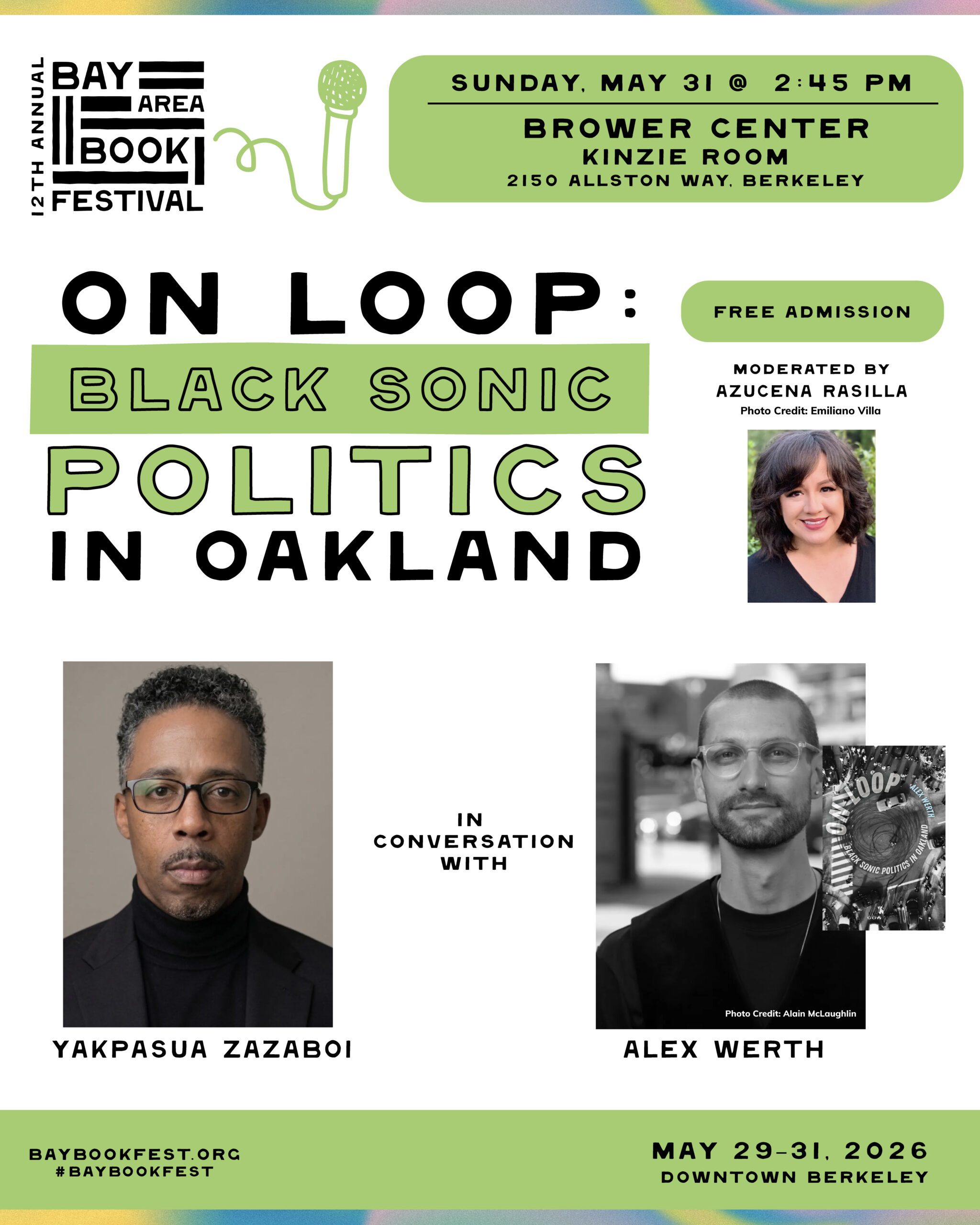
On Loop is available at Oakland’s East Bay Book Sellers.
Reprinted from On Loop: Black Sonic Politics in Oakland by Alex Werth, courtesy of University of California Press. Copyright 2025.
Author
