
Remembering Carl Anthony, Oakland environmental justice leader and urban planner
Carl Anthony, pioneer of environmental justice movement, dies at 87
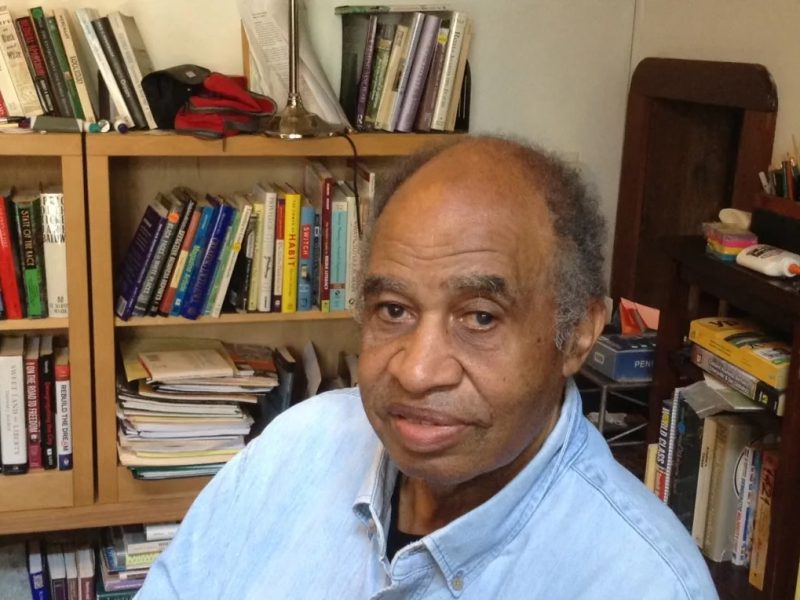
This obituary originally appeared on The Oaklandside, and is republished with permission of the family of Carl C. Anthony.
Carl Cokine Anthony, a Berkeley resident, architect, city planner and leader in the environmental justice movement, passed away on April 4 at 87. In a career spanning decades, he redefined the relationship between racial equity, regionalism and the environment — and founded an environmental organization in Oakland.
Carl was born on Feb. 8, 1939, in Philadelphia, to Mildred Anthony (née Cokine) and Lewis Anthony. His father, highly educated and able to read and write Latin and Greek, was a house painter and paper hanger and started a Depression-era Philadelphia Food Cooperative. Mildred cared for the family and was artistically gifted with a talent for sewing. Carl had one older sibling, Lewis Edward Anthony (“Lewie”), who was 16 months his senior.
Raised in West Philadelphia, Carl attended B.B. Comegys Elementary School. It was there that his interest in city planning was sparked by his third-grade teacher, Ms. Aikens, when she took their class to the Better Philadelphia Exhibition that had a display of what Philadelphia would look like in 25 years. Carl described Ms. Aikens as “the teacher who would open up the world to me.”
Outside of school, Carl and his brother worked long hours cleaning, fixing up and painting houses under their father’s direction from the ages of 7 and 8. Carl attended Tilden Middle School and Dobbins Vocational High School. At Dobbins, his teachers were impressed by his drawings and suggested that he transfer to the architectural drafting homeroom, which fostered his interest in architecture.
At age 16, he was forced by his father to leave high school and resume working with his hands.
Carl Anthony with his son Khalil. Courtesy of the Anthony family
After returning to school and completing his studies at Temple University High School, Carl worked at the Witherspoon Library of the Presbyterian Historical Society, where he discovered that books could help answer his many questions about his place in the world.
During that time, he was introduced to and moved by the writings of Lewis Mumford and began to be drawn to a future in architecture. Carl’s love of reading continued throughout his life, as he bought every book he thought interesting.
Carl went on to attend Columbia University in New York City, working as a night janitor while taking daytime classes. While in New York City, in 1962, he also became involved in the Northern Student Movement for civil rights, co-founding a tutoring project, the Harlem Education Project. He was the sole African American student when he entered Architecture School at Columbia and graduated with a Bachelor of Arts in Architecture degree in 1969. Toward the end of his studies, Carl made a tour of Historically Black Colleges and Universities (HBCUs), encouraging students to apply to study at Columbia School of Architecture, and applications to Columbia University from Black students increased.
In 1970, Carl used his architecture school travel grant to study African traditional building in Spain and West Africa.
From 1971 to 1979, he was Assistant Professor of Architecture at the UC Berkeley College of Environmental Design.
He later co-created Anthony, Fleming & Assoc., Oakland. In 1988, Anthony was appointed to the board of Earth Island Institute by its founder, David Brower. There, he co-founded, with Karl Linn, the Urban Habitat Program, a groundbreaking initiative to cultivate multicultural leadership in environmental justice movements. With Luke Cole, he produced Race, Poverty and the Environment, a quarterly magazine, which became a vital platform for advancing environmental justice discourse nationwide.
Carl was a fellow at Harvard University’s John F. Kennedy School of Government in 1996. From 2001 to 2008, he shaped national conversations on the environment and equity as Director of the Ford Foundation’s Sustainable Metropolitan Communities Initiative in New York, NY.
Upon returning to Berkeley, he co-founded Breakthrough Communities in Oakland, a project that built on and expanded the many strategies and environmentally equitable programs he had funded during his time at the Ford Foundation.
His book, “The Earth, The City, and the Hidden Narrative of Race,” published in 2017, interweaves his personal experiences with the broader history of urban planning, racial equity, and environmental and social justice.
Carl served on numerous boards and commissions, including the Berkeley Planning Commission, the Presidio Council, the East Bay Conversion and Reinvestment Commission, which guided the transformation of decommissioned military bases toward community benefit, the board of the San Francisco Planning and Research Commission, and the Gamaliel Foundation. He was appointed to the U.S. Environmental Protection Agency’s National Environmental Justice Advisory Council and to the President’s Council on Sustainable Development. Later, he served on the Board of Directors for Berkeley’s Chavez Park Conservancy and participated in the Alameda County Brotherhood of Elders.
Carl was a visionary leader who inspired a generation to understand the integral connections between the exploitation of poor people and people of color, and the degradation of our planet and its natural resources. He was generous with his time and opened the potential for new and just possibilities, whether he was speaking with students in kindergarten classrooms or in the halls of higher education. He was an educator and mentor to many.
Carl Anthony is survived by his family: son, Khalil Doak-Anthony, and his mother, Jean Doak; grandson, Makai Sloane-Anthony, and his mother, Stacia Sloane; sister-in-law, Gwendolyn Anthony; niece Robin Anthony Kouyaté, her husband Ousmane Kouyaté, and their children: Jasmine Kouyaté and N’Faly Kouyaté; and cousins: A. Paula Campbell with husband Kebere Kiross, and Leslie Silver. Carl was predeceased by his brother, Lewis.
Details about a memorial celebration will be made available as they are finalized. For updates, visit the Urban Habitat website.