
Editor’s note: An original article was first published at the Contra Costa Youth Journalism program, reported by Keerthi Eraniyan, a 9th grader at California High School in San Ramon.
It’s becoming commonplace in open-intake shelters and rescue facilities across the Bay Area: The number of unadopted pets is growing; animal caretakers and staff are stretched thin; and efforts by local municipalities to provide care and comfort to every animal surrendered is becoming increasingly difficult.
“Things have gotten a lot harder,” said Ann Dunn, director of Oakland Animal Services. The shelter is currently taking in an average of 340 new dogs per month, what she describes as a “relentless increase in intake,” particularly of big dogs, who need more space. “Every shelter is struggling right now, especially with big dogs.”
California animal shelters and rescue organizations – even those across the country – are similarly experiencing an overflow crisis. The number of stray dogs taken into shelters rose 6% from 2022 statistics and 22% from 2021, according to Shelter Animals Count.
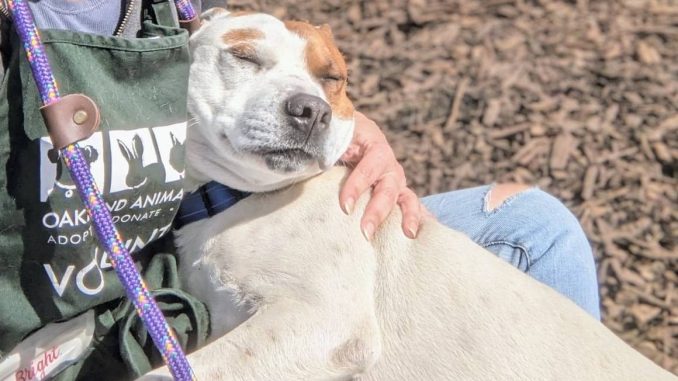
But at a time when animal shelters across the board are fighting an uphill battle, Oakland’s shelter is making remarkable strides – in large part due to their volunteer fostering efforts and because of community members. While more dogs are being turned in to the shelter each day, the total number of adoptions per year has tripled since 2019, and a new dog fostering program has help saved animals’ lives.
Oakland’s Animal Crisis Likely Caused by Housing Crisis, Economy
During the pandemic, there was a spike in animal adoptions, as people found themselves with more time spent at home, and facing increasing isolation and loneliness. Shelters had waiting lists for people eager to adopt.
But starting in early 2023, animal shelters started seeing massive numbers of dogs and cats being turned in.
People are dealing with a housing and economic crisis, leading to an animal shelter crisis.
Dunn of OAS said that about half of surrendered pets – those brought in by their owners, versus strays brought in – are due to housing or economic issues.
“We’re seeing a doubling of surrendered animals, largely people telling us they are newly homeless, or they are choosing between finding affordable housing and having a pet. People are giving up their own pets,” Dunn said. The shelter takes in surrendered animals from Oakland residents, or strays found in Oakland.
The number of dogs turned in, whether strays or owner surrenders, is staggering. In 2023, the shelter took in 3,618 new dogs. In 2022, the shelter took in 2,852 new dogs that year, already a high at that time. The shelter is now averaging 341 new dogs a month, a 13% increase from 2023.
Another factor is that dogs require a higher amount of human-animal interaction. When owners worked from home during quarantine, a dog would get used to being with the owner at all times. When the owner returned to in-person work, their human parents weren’t able to give their dog the same amount of attention as before. At times, this resulted in owners not being able to take care of the pet.
“They might have loved the animal – particularly when they’re home and [when] they needed the companionship. They learned that it can be difficult with the dog if you’re gone long, long hours,” said Sue James, board president of the Tri-Valley Animal Rescue.
Euthanasia a Last Resort
Large dogs, in particular, become targets for euthanization because there is limited space in most shelters for large dogs.
Rescue organizations such as the Tri-Valley Animal Rescue take on the overflow from open-intake shelters, which possess a legal obligation to take in any stray animal from their jurisdiction brought surrendered to their facility by Animal Control or the public.
About 920,000 shelter dogs and cats are euthanized annually, according to the American Society for the Prevention of Cruelty to Animals (ASPCA).
One challenge is the cost of spaying and neutering animals, said Amanda Lee of the Underdog Animal Rescue in Lafayette.
“Pretty much nowhere, in the Bay Area specifically, do we have what we call no-cost, or low-cost spay and neuter clinics,” Lee said. “We used to before COVID, and most shelters had some sort of option, but now because everything’s running just differently in general, there’s very few options.”
While there’s a range of cost for spaying or neutering, depending on the size and gender of the dog, and location, the price can be steep. According to Lee, spay and neuter services at the average veterinarian clinic start at around $700.
“The only reason that overpopulation is a problem is because there is not enough spay and neuter happening,” Lee said. “[There is] not enough education behind it, not enough resources.”
Sue James of Tri-Valley Aniimal Rescue added that people buying from breeders raises a problem. “If people would learn more about the joys of adopting shelter animals and saving their lives perhaps more people would adopt versus buy,” James said.
Less Euthanizations, More Fostering in Oakland

In Oakland, the euthanasia rate for dogs has actually gone down over the years. In 2019, 16.6 percent of dogs that came into the shelter were euthanized, while in 2021, 2022 and 2023, the rates were 7.2, 5.5, and 5.5, respectively, according to OAS.
A huge part of why euthanasia rates have gone down in Oakland is because of a relatively new fostering program, specifically for big dogs. OAS and the nonprofit Friends of Oakland Animal Services partnered together to form the new fostering program, which started in June of 2020.
Currently, 105 dogs are in a foster home. More than 1,000 dogs were fostered last year.
Dunn credits this program for dropping their euthanasia rates, from a high of 17 percent, to now around 5 percent. The shelter has 80 total kennels for dogs, and about 73 are used for big dogs. However, they now average a daily intake of 12-14 new dogs everyday. “You can imagine how quickly those kennels fill up,” Dunn said.
“When we run out of space, we have no choice but to euthanize,” Dunn, who herself started as an OAS volunteer in 2009 before becoming the director in February 2020, said. “Getting dogs into a foster home buys time for them. That is the most significant thing that has changed.”
The number of people fostering dogs from OAS has also increased 40% over the last year, according to OAS.
“Our community is stepping up in such a huge way,” Dunn said.
Through fostering, people can enjoy the benefits of owning a pet without too much additional costs or commitment. Most shelters provide veterinary services, food, and materials for foster families.
“[Fostering is] very similar to babysitting your friend’s dog,” Lee said. “You’re providing shelter, love, care and boundaries. If you save multiple per year, that number just keeps multiplying.”
The Power of Social Media
In 2019, 400 dogs were adopted through OAS. In 2023, that number jumped to 1,600. Cats, similarly, had a jump from 850 adoptions to 1,800 in the same time span.
The organization has made concerted “drives” to get animals into homes, and out of the shelter, and in order to avoid euthanizing adoptable animals.
The campaigns, run largely through social media as well outreach through OAS’ community of volunteers and fosters, is one of the reasons why there’s been an increase in adoptions, according to Dunn. Her staff estimates that their Instagram followers have tripled in the past six years. Oakland Animal Services’ Instagram account, run by dedicated volunteers, now has 31,000 followers, and is steadily growing. (OAS was previously run by the Oakland Police Department. Now, it is its own department within the City of Oakland).
In early 2023, with an increase of new animals being turned in, OAS asked the public for help. “It was the first time we said publicly that we are contemplating euthanizing for space,” Dunn said.
Their campaign, “50 dogs in 5 days” – a plea for people to adopt 50 dogs in a short amount of time to avoid euthanization – was hugely successful. Ninety dogs were adopted in that time span, and adoptees came from all over the Bay Area.
“We Need the Community to Stay Focused, To Stay Positive”
Dunn says the power of community matters a lot when it comes to shelters and saving animals. However, she says that she is starting to see a lot of fatigue among staff, community members, and volunteers, a feeling that the problem is insurmountable.
“What I want people to understand is despite how hard it has gotten for us, we are still serving large numbers of animals,” Dunn said. “But we can only do this with the help of the community. We need the community to stay focused, to stay positive, and to stay hopeful.”
Dunn said that the hardest part is facing the idea of possibly euthanizing for space, especially when it comes to dogs that are adoptable. “We have to live with the decision we make,” Dunn said. “And that takes a mental health toll on our staff. It’s an extremely challenging situation.”
But, she remains hopeful.
“We can absolutely change this,” Dunn added. “It’s not impossible. The ways that people can make a difference is essential.”
+ + +
Additional reporting by Keerthi Eraniyan, a 9th grader at California High School in San Ramon who is a part of the Contra Costa Youth Journalism program.


Be the first to comment