
Nonprofit leaders and state regulators say the recent collapse of Oakland-based Flipcause highlights the challenges of regulating online donations platforms.
In 2021, the state passed donation platform law, AB 488. The law was meant to regulate online charity fundraising platforms and ensure charities were in “good standing” with the state.
But the sheer volume of online activity has been overwhelming. Monitoring the various platforms is a challenge. State officials said they don’t even know how many are operating.
Enforcement of the law has also left some nonprofits unable to collect donations because they aren’t in good standing with a state registry.
“We are concerned that the number of registered charitable fundraising platforms is low. We are reviewing the market and determining which unregistered platforms to send notices to register.” Brian Armstrong, supervising deputy attorney general, California Department of Justice
At the Assembly Privacy and Protection Committee’s first “outcomes review” on Feb. 17, state regulators, nonprofit leaders, and lawmakers discussed the law’s effectiveness.
“Online solicitations are pervasive and ubiquitous,” Brian Armstrong, supervising deputy attorney general, told the committee.
Flipcause fiasco exposed oversight gaps
The attorney general’s office does not know how companies are operating in California or how many are out of compliance with state law, Armstrong said.
“We are concerned that the number of registered charitable fundraising platforms is low,” Armstrong said. “We are reviewing the market and determining which unregistered platforms to send notices to register.”
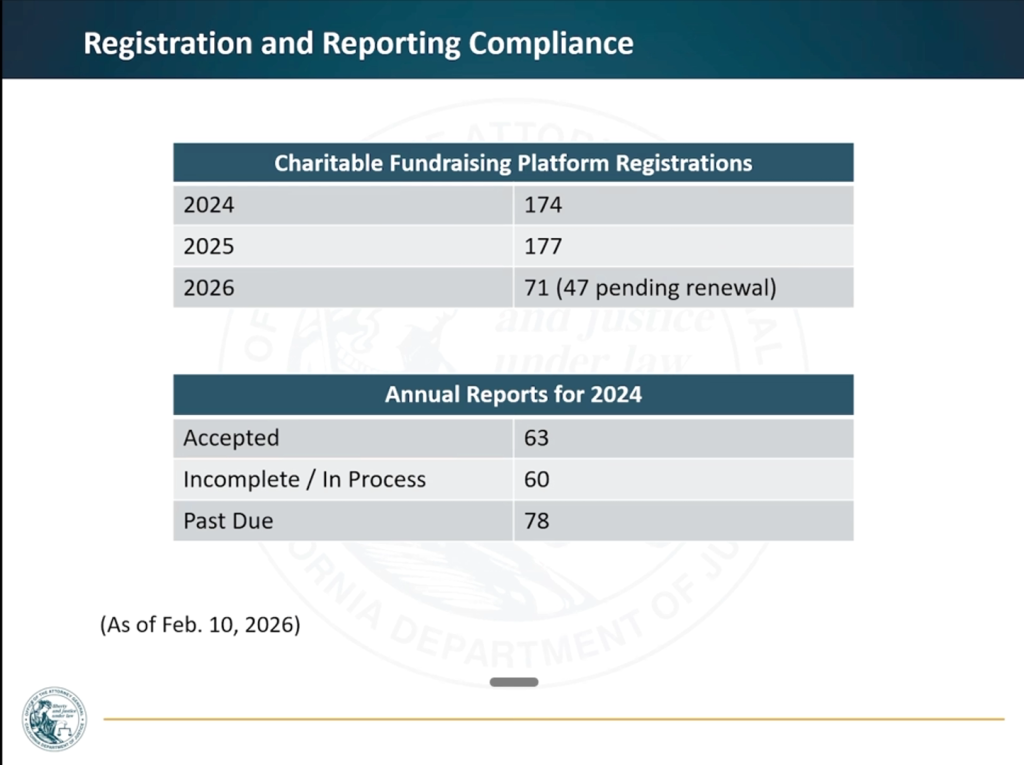
The law requires companies to register annually. But it doesn’t account for companies that were previously registered, but didn’t renew, or those who registered for the first time. For example in 2024, there were 174 companies registered, according to Armstrong’s presentation. The next year, there were 177, but there was no distinction on which were new and which were returning.
An Oakland Voices analysis last December found that nearly one in five donation platforms—including Flipcause—weren’t registered.
The law also required companies to file annual reports. For 2024, the California DOJ accepted 63 reports. Sixty were incomplete, and 78 of reports for registered companies are past due, according to Armstrong. This adds up to 198 organizations, more than were reported registered. The DOJ maintains a list of all charities, fundraisers, and charitable fundraising platforms, called the Registry of Charities and Fundraisers.
“Given limited fixed resources, the Registry has been unable to process submissions as quickly as we would like,” Armstrong testified. He added that a new online filing system would be implemented in summer 2026.
Flipcause, which Armstrong noted as an example of an unregistered donation platform, owes nearly $29 million to more than 3,200 nonprofits nationwide.
The state filed a cease and desist order against Flipcause, and when the company filed for bankruptcy, Armstrong said, the attorney general’s office convinced the bankruptcy court to install an independent trustee to manage the company’s assets.
Flipcause appealed the cease and desist order.
California’s donation platform law ‘a mixed bag’
Geoff Green, CEO of Cal Nonprofits, said that California’s landmark donation platform legislation has been a “mixed bag.”
While AB 488 increased donation platform transparency, state requirements and outdated technology have led to “fatal” delays for small nonprofits, Green said.
There are more than 110,000 tax-exempt nonprofit organizations in California, according to the DOJ. About 30,000 of those nonprofits are not registered with the state.
“When you’re frozen out of fundraising efforts and the majority of fundraising is now online, that’s a big problem.”
Geoff Green
State law requires donation platforms to notify organizations if they not are in “good standing” with the Registry of Charities and Fundraisers. Some nonprofits only found out about their status when a donation platform stopped collecting donations.
“Most nonprofits first heard about it from their fundraising platform saying ‘we can no longer give you a cent,’” Green testified. This could interrupt nonprofit operations, especially smaller groups with no staff. “When you’re frozen out of fundraising efforts and the majority of fundraising is now online, that’s a big problem.”
Green credited Oakland Voices with breaking the Flipcause story.

Donation platforms find compliance expensive, but enhance transparency
Two industry representatives from PayPal and GoFundMe testified at the hearing.
Nick Aldridge, CEO of PayPal Giving Fund, said platforms support the regulation, in concept, it’s been a costly process.
“We invested around five person-years,” he said, “updating websites, policies, and reporting systems.”
The negative consequences of the law include the delisting of charities and slow state response. Aldridge said micro-donation programs, like rounding up change at the grocery checkout, have closed or never launched.
“These organizations are facing increased administrative burden, uncertain timelines, and disruption to fundraising at critical moments.”
Emily Barton, senior director of policy engagement, GoFundMe
The transparency and oversight requirements created “unintended consequences” for nonprofits, said Emily Barson, senior director of policy engagement at GoFundMe.
“These organizations are facing increased administrative burden, uncertain timelines, and disruption to fundraising at critical moments,” said Barson. The law needs to balance protecting donors, allowing charities to fundraise, and enabling platforms to innovate, she said.
The committee chair, Assemblymember Rebecca Bauer-Kahan, said that the hearing was missing the perspective of donors. She added that the suggestions from industry favored nonprofits over donors. At the hearing, both Bauer-Kahan and Armstrong criticized GoFundMe’s recent unauthorized creation of fundraising pages for nonprofits.
The road to adopting platform oversight
California first started discussing online giving regulations in 2018, according to Assemblymember Jacqueline Irwin, author of AB 488.. Before the Covid-19 pandemic, the state lacked clear oversight for online platforms. Fundraising laws regulating charities focused on paper checks and telephone solicitations.
At the time, donation platforms sometimes held donations for long periods. Others had solicited donations without the consent of charities, Armstong said. Donors had contributed to platforms while believing they were giving to a charity.
California’s law required charitable fundraising platforms to register and report donations. The first in the nation, the law took effect in 2024. Hawaii adopted similar legislation which takes effect this July.
Updating platform law: AB 2221
Lawmakers signalled that a few updates could improve implementation of the law. Assemblymember Irwin proposed a new bill this year, AB 2221. The law would clarify streamline the state’s processing of changes and increase transparency to donors.
The proposed law would make platforms distribute donations to nonprofits in “good standing,” unless exempt by law. Platforms will have to notify donors if a charity might not receive funds, and what will happen with the money.
The state would have to approve registration and reports within 10 business days, unless the state identified an issue. The bill would also create a formal appeal process for decisions related to the Registry.
Disclosure: This story used CalMatters’ AI tools to assist with reviewing the legislative hearing template. We reviewed the transcript posted to Digital Democracy and the video to ensure accuracy. This tool to search Flipcause enabled us to find this hearing and quickly identify statements about donation platform oversight.


Be the first to comment