
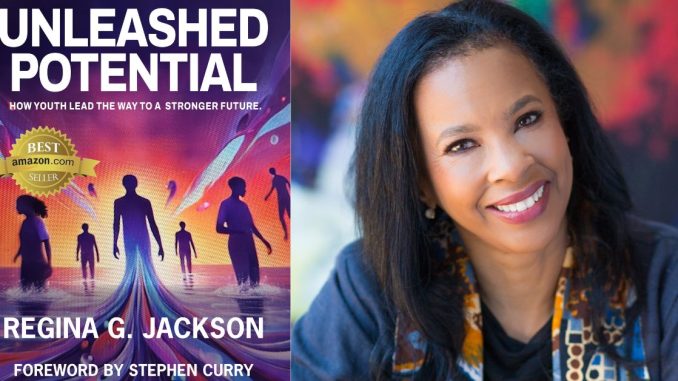
Editor’s Note: Regina Jackson is the author of “Unleashed Potential – How youth lead the way to a stronger future.” The excerpt below discusses “The Michelangelo Effect,” a foundational pillar of the books philosophy. This section explains how transformation is cultivated through vision, standards, structure, and love.
The Michelangelo Effect: Seeing What Already Exists
I remember a young person who walked through the doors of the East Oakland Youth Development Center for the first time with his head down and his guard all the way up.
He wasn’t disruptive, but he wasn’t engaged either. He had already learned, at a young age, how to move through the world without being seen too closely. School hadn’t worked for him. Authority figures hadn’t earned his trust. And like so many young people in Oakland, he had begun to internalize a narrative about who he was—one shaped more by limitation than possibility.
But what I saw was something else.
I saw leadership. I saw intelligence. I saw creativity. I saw a young person who had not yet been given the environment, the language, or the opportunity to fully express who he already was.
That belief—that within every young person exists unrealized brilliance—is at the core of what I call the Michelangelo Effect.
Michelangelo once said that when he sculpted, he did not create the figure; he simply removed the excess stone to reveal what was already there. The masterpiece already existed within the marble. His role was to uncover it.
This is how I have come to understand young people. And not just young people—but communities.
The work is not to create potential. The work is to recognize it, nurture it, and remove the barriers that prevent it from being fully realized.
For too long, many of our systems—education, public safety, even health—have been designed around deficit. They ask: What’s wrong? What’s missing? What needs to be fixed? And in doing so, they often overlook the inherent strengths, resilience, and possibility that already exist within the very people they aim to serve.
At the East Oakland Youth Development Center, we chose a different path.
Believing in Transforming Youth
We built an environment rooted in belief—belief that every young person who walked through our doors carried within them the capacity for greatness. But belief alone is not enough. It must be paired with structure, opportunity, and accountability. Young people need spaces where they are both supported and challenged, where expectations are high and relationships are real.
We focused on character-based leadership, emotional intelligence, and identity development—not as abstract ideals, but as daily practices. We created a culture where young people could begin to see themselves differently, not defined by their circumstances, but by their potential.
And something powerful happens when that shift takes place.
Young people begin to make different decisions. They take ownership. They imagine futures that once felt out of reach. They begin to lead.
I have watched this transformation happen thousands of times. And each time, it reaffirms the same truth: when you change how a young person sees themselves, you change the trajectory of their life.
But this is not just about individual transformation. This is about systems.
How do systems limit youth potential?
Because if we truly believe that potential already exists within our young people, then we must ask ourselves a more difficult question:
What in our systems is preventing that potential from being realized?
What would it look like if our schools were designed to cultivate identity and leadership, not just academic performance?
What would it look like if our public safety systems prioritized trust, dignity, and accountability?
What would it look like if our health systems recognized the impact of environment, trauma, and opportunity on well-being?
What would it look like if we stopped asking how to fix young people, and instead asked how to align our institutions to support who they already are and who they are becoming?
In Oakland, we are uniquely positioned to answer these questions.
We are a city of innovation, resilience, and deep community wisdom. We are also a city that has experienced the consequences of fragmented systems—where too often, institutions operate in silos, and the burden of navigating those systems falls on the very families they are meant to serve.
Oakland’s next chapter
The next chapter of Oakland’s progress will require something different.
It will require us to work across sectors—to bring together education, health, government, philanthropy, and community—not just to collaborate, but to align around a shared vision for our children and families.
It will require us to center the voices of those closest to the challenges—because they are also closest to the solutions.
And it will require us to shift our mindset—from scarcity to possibility, from deficit to potential.
The Michelangelo Effect is not just a philosophy. It is a call to action.
It asks each of us—educators, policymakers, community leaders, and neighbors—to reconsider how we see the people around us.
Who are we willing to see?
What assumptions are we willing to let go of?
What systems are we willing to redesign so that they no longer obscure potential, but reveal it?
Because our young people are not waiting to be fixed. They are waiting to be seen.
And when we truly see them—when we invest in them, challenge them, and stand beside them—we don’t just change individual lives.
We change communities.
We change systems.
And ultimately, we change what is possible for Oakland.
UPCOMING EVENTS FOR REGINA JACKSON
- Independent Sector Virtual Launch, April 1, 11 a.m PST
- United Negro College Fund United Conference, July 19-23, Atlanta, GA, and
- Independent Sector National Summit, October 13-16, Phoenix, AZ


Be the first to comment