

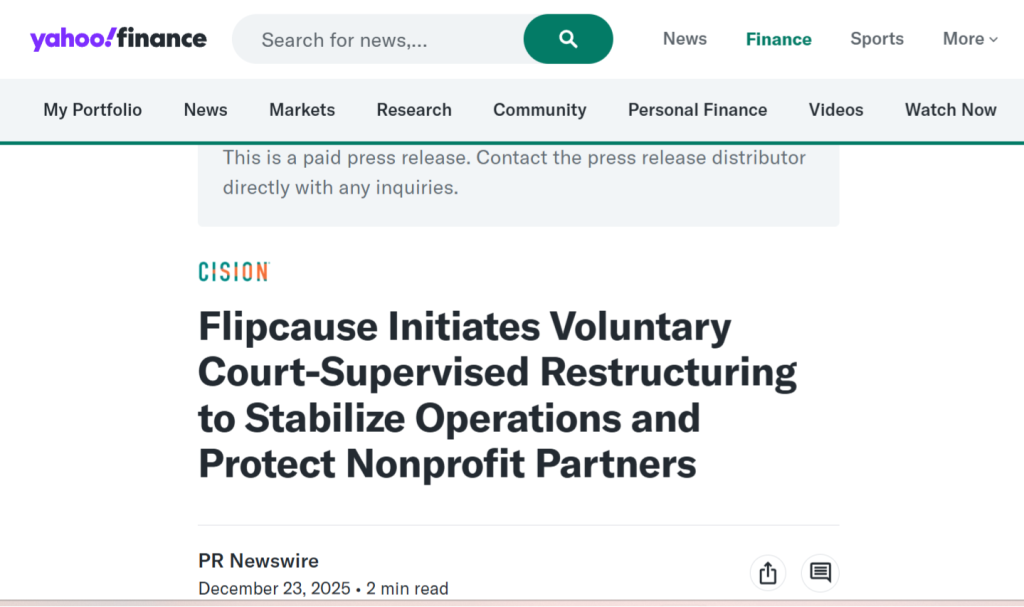
Flipcause described its Chapter 11 bankruptcy as a “voluntary court-supervised restructuring” in a press release that omits the word “bankruptcy” and the $29 million owed to nonprofit organizations nationwide.
The Dec. 23 press release includes the first public statements from CEO Sean Wheeler and Executive Chairman Emerson Ravyn since Oakland Voices began reporting that Flipcause was withholding donations.
While the statement emphasizes the platform’s history supporting nonprofits and claims to offer “clarity,” “accountability,” and “transparency,” in its attempt to sell the company, there is no mention of its operational or regulatory challenges.
Flipcause reframes bankruptcy, financial issues
Delaware bankruptcy court filings tell a different story. Flipcause is at least $10 million in debt. The company lists $20 million in assets, including $15 million for its website, and $30 million owed to “creditors,” which includes both investors and nonprofit organizations.
CEO Sean Wheeler said, “This process allows us to continue supporting our nonprofit partners while working through a structured and transparent resolution with the court and stakeholders.”
Court filings show Flipcause has just $70,000 in a Citibank account and owes $1.225 million to eight investors and lenders, and $11,000 to employees and contractors.
“This process allows us to continue supporting our nonprofit partners while working through a structured and transparent resolution with the court and stakeholders.”
Flipcause CEO Sean Wheeler
The release neither mentions the word “bankruptcy” nor does it not mention the more than $29 million owed to its 3,276 nonprofit clients.
The release describes payment processing as “temporarily paused” due to “an upstream service provider.” On Dec. 4, fintech giant Stripe, Inc. cut off service to Flipcause, without explanation, Flipcause told customers earlier this month.
“At this time, certain platform functions supported by an upstream service provider are temporarily paused, including payment processing, the acceptance of new contributions, and certain data export or migration capabilities,” the statement reads.
In a sworn declaration, Ravyn said Stripe informed Flipcause of an internal review on Dec. 2 and cut off service two days later, freezing $1.145 million in a reserve account until February 28, 2026.
Flipcause asked the court to order Stripe to resume services and release the funds. Stripe objected to the motion at a Dec. 22 bankruptcy hearing.
Flipcause’s mounting legal woes
The press release also makes no mention of government enforcement actions or lawsuits against the company.
On Nov. 12, California Attorney General Rob Bonta issued a cease and desist order asserting that Flipcause operated as an unregistered “charitable fundraising platform.” The order demanded Flipcause cease all operations immediately, provide an accounting of its business for the past decade, place its assets in a blocked bank account, and penalized the company $70,000.
Flipcause appealed the order on Dec. 12, arguing that it was not subject to California’s fundraising platform regulations. Bonta’s office filed a motion to appear at Monday’s hearing. Reached by phone on Dec. 22, California Department of Justice attorney James S. McPherson declined to comment and referred Oakland Voices to the attorney general’s press office–who did not respond to a voicemail.
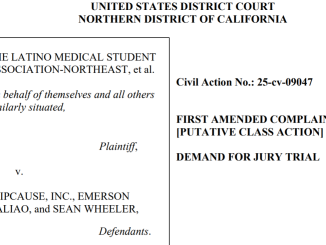
Court records also reference various lawsuits, like a proposed federal class action suit against Flipcause, and complaints to multiple state attorney generals.
California Attorney General Rob Bonta issued guidance to nonprofits affected by Flipcause on the same day as Flipcause’s press release.
Flipcause tried to sell company for three years
The press release characterizes the bankruptcy as following an “extended evaluation of strategic alternatives, including a potential transaction that did not ultimately proceed.”
Court records detail a failed three-year effort to sell the company. Flipcause began seeking a buyer in 2022 and hired an investment banker in 2023. The company conducted an auction in July 2025, but received no bids, and continued to seek buyers through November. By October, Ravyn declared to the court, Flipcause realized they would not find a buyer.
During this period, the company continued operating while betting on a sale that never happened.
Over the past year, complaints of delayed and withheld donation transfers mounted. Neither the press release nor court documents explain why Flipcause continued accepting donations while trying to sell the company, or when executives realized they could not distribute donations to nonprofits.
Flipcause seeks buyer for auction
Flipcause is attempting to sell the company through a bankruptcy auction scheduled for March 3, 2026. The company does not yet have a lead bidder, what the court calls a “stalking horse.” According to bidding procedures posted online, Flipcause must identify a lead bidder by Feb. 4. Potential buyers must submit a deposit of at least $250,000 or five percent of their offer, whichever amount is greater.
The sale will include “substantially all of the Debtor’s assets,” which includes the Flipcause brand, platform, and current customer contracts. The buyer may choose to reject contracts.
The acquisition of assets will be “free and clear” of the $29 million owed to nonprofits, meaning they would not inherit the debt. Proceeds from the sale would go to creditors. According to bankruptcy law, this would mean secured creditors and administrative costs will be paid first, and unsecured creditors will split what remains.
“This process is about clarity, accountability, and long-term stability. We are committed to working closely with the court and trustee to ensure transparency, protect enterprise value, and support a fair and structured outcome for all stakeholders.”
Emerson Ravyn, Flipcause Executive Chairman
Flipcause touts its history, scale
The release states that Flipcause has supported more than 10,000 nonprofit organizations and processed over $1 billion in total transactions through the platform since its founding in 2012.
In the statement, Ravyn said: “This process is about clarity, accountability, and long-term stability. We are committed to working closely with the court and trustee to ensure transparency, protect enterprise value, and support a fair and structured outcome for all stakeholders.”
Court documents show that Flipcause valued its own platform at $15 million. The company has $30 million in liabilities against $20 million in assets, leaving a $10 million shortfall.
Flipcause owes eight “secured” creditors $1.225 million. It is unclear how much money owed to nonprofits, the 3,276 “unsecured” creditors, will be recovered.
Flipcause’s operations limited
Flipcause will continue to operate during the bankruptcy process and its appeal of the attorney general’s order, according to the release.
“Nonprofit websites hosted by Flipcause remain live, and organizations continue to have access to donor management tools, reporting, account management dashboards, and customer support,” the release stated. Future communication to the public will be through court filings.
With its assets frozen, unable to pay 11 employees, it is unclear what customer support Flipcause can provide. Flipcause is seeking court approval to pay $11,000 in unpaid wages and maintain $5,380 in monthly health benefits.

Flipcause distributed the press release through eReleases, a commercial press release service that charges $399 to $699 for national placement, including Yahoo! Finance.
Oakland Voices called the number listed and left a message on the automated voicemail. No one has responded.
Oakland Voices also visited a Hawaii address Wheeler used in corporate filings, but property records show someone else lives there.



Be the first to comment