
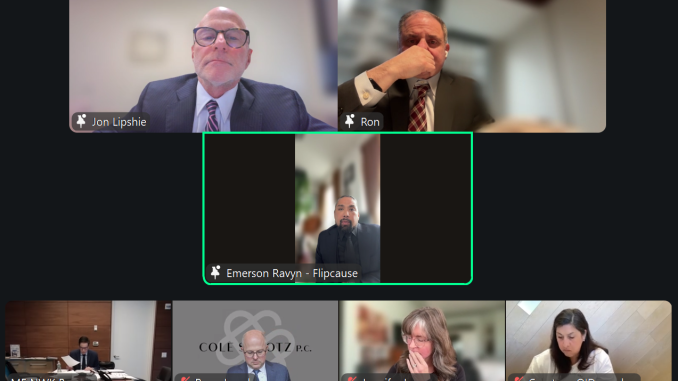
More than 150 nonprofit leaders logged into a Zoom in early March seeking answers.
After months of stalling, denials and excuses they just wanted to know what happened to millions of dollars in missing donations.
Flipcause, a donation platform, declared bankruptcy in December and made them “unsecured creditors.”
As the meeting got underway, former executive chairman Emerson Ravyn began to express sympathy to a representative of one of the more than 3,200 former clients owed money.
“You can save the pleasantries,” said Garrett Ashmore of Stuff the Sleigh, which is owed $23,955.04.
Over two dozen people waited hours to question Ravyn about missing payments. At one point, when asked a question, Ravyn dropped off the call. The moment only added to the frustration.
Typically, creditor’s meetings in bankruptcy hearings can take less than half an hour.
This one lasted three hours.
Flipcause’s December 2025 filing revealed that the Oakland-based fundraising platform owed nearly $29 million to more than 3,200 nonprofit organizations.
Bankruptcy format offered little clarity
This was the first session that allowed nonprofits to question Ravyn’s leadership about Flipcause’s finances and operations.
An hour in, more than 194 participants were on the Zoom. Participants included California Deputy Attorney General Kim Kasreliovich and a representative for the Kansas attorney general’s office.
Throughout the meeting, the orderly process of bankruptcy law seemed to subdue an undercurrent of rage from nonprofits who demanded answers and did not get clear responses.
“When you speak about the donations from nonprofits considered assets and you then take those assets and invest in other things, is it a little bit like a ponzi scheme?”
Amanda Cordona
The meeting followed a semi-structured format. U.S. Trustee Jon Lipshie and independent bankruptcy Jeffrey Testa each took turns asking Ravyn about the company’s finances. Trustee Lipshie limited comments and, at times, he limited the number of questions participants could ask.
For some nonprofits, the process offered little clarity on what happened to donations and what they could do now. Some organizations said they were debating whether to write off the funds, with an expectation that they will never receive the money donated through Flipcause.
Amanda Cordano, executive director of Miss President US, compared the situation to a “ponzi scheme.”
“When you speak about the donations from nonprofits considered assets and you then take those assets and invest in other things, is it a little bit like a ponzi scheme?” she asked.
“Sounds like a lot of other people will get paid before our nonprofits whose money you used.”
Under bankruptcy law, assets are redistributed based on a hierarchy. In the case of Flipcause, the company’s assets will first pay the investment banker that led the sale process. Then, bankruptcy lawyers, investors, and if anything remains, nonprofit organizations will split the remaining assets.
Cordano added, “We’re the last ones to get paid. I find that reprehensible.”
What happened to the money?
Speakers shared the hardships experienced by their organizations. Many represented small nonprofits without the means to hire attorneys, they said.
“It’s hard not to get emotional given how much we love our donors and our community,” said Carlos Fernandez with Seattle’s Space Between. Flipcause owes this organization $21,675.40.
Allie Renar with Washington-state based Sahar Education said her organization’s donors were concerned about claiming tax deductions since $19,493.08 never reached their cause.
“Our operations have been consistent since the founding of the company.”
Emerson Ravyn, Flipcause Co-Founder
Ravyn, who appeared in a black shirt, black tie, and black coat, provided few answers. Instead of a detailed breakdown, he said the company’s books and records – now controlled by a Chapter 11 trustee – would need to be reviewed.
Juyoun Han, attorney for a proposed class action lawsuit with more than 70 clients, questioned Flipcause’s “business model” which commingled nonprofit funds.
“Our operations have been consistent since the founding of the company,” Ravyn said.
He added that Stripe, the payment processor that cut off services to Flipcause in December, had approved its business model, and he stated the California attorney general’s office reviewed it in 2019.
During the hearing, Oakland Voices asked Ravyn what safeguards existed to ensure nonprofits would receive their donations. Ravyn responded that the company managed payments by balancing “inflows against outflows.”
When asked whether delayed payments to nonprofits were the result of a lack of funds, and not simply an ACH issue as previously claimed, Ravyn said “multiple systems” were involved in payment processing, which was done after risk controls were assessed.
When Oakland Voices asked about the documentation of risk controls, Ravyn said that information could be provided to the trustee.
Why Flipcause collapsed
Flipcause faced liquidity constraints in 2025 after a three-year effort to sell the company failed, Ravyn said. Flipcause processed $100 million annually during that time, he said. Declining payment volume and the failed deal left the company unable to meet its obligations, Ravyn said.
“We can’t pay bills with a payable.”
Christine Bell, Urban Neighborhoods Initiative
Ravyn testified that Flipcause operated under a “merchant of record” business model. The company treated donations as company assets upon receipt. The company’s ledger then recorded these donations as payables to nonprofits. The donations and Flipcause funds were deposited into a single bank account. That account held income and outcoming payments— instead of setting aside money for each nonprofit.
By comparison, Software4Nonprofits, the company that purchased Flipcause through the bankruptcy sale, said donations made through its platform go directly to nonprofit bank accounts.
When asked where the money went, Ravyn said each organization had a “payable” in Flipcause’s ledger.
“We can’t pay bills with a payable,” Christine Bell with Urban Neighborhoods Initiative in Detroit told Ravyn.
Ravyn sole decision maker for payouts
Bankruptcy filings showed Flipcause paid Ravyn and other Flipcause insiders more than $3.8 million. This included other entities controlled by Ravyn, his brother, former Flipcause CEO Ro Valiao, who also goes by Romeo Ocean, and CEO Sean Wheeler.
Upon questioning, Ravyn said he had been the sole director of the company’s board for four years. Meaning, he alone approved key financial decisions, such as external investments in his companies. He said Flipcause used funds for operations and investments in affiliated ventures.
As Ashmore pressed Ravyn to specify how much money had personally been paid out in recent years, U.S. Trustee Jon Lipshie intervened.
“Was it more than $5 million?” Lipshie asked.
“Yes,” Ravyn said.
“Was it more than $10 million?”
“I don’t know that.”
Then Ravyn’s phone dropped. The silence, a reminder of the long wait for answers nonprofits have experienced.
When he rejoined the meeting, Lipshie repeated the question. Ravyn again said he was not sure, but that he had provided the information to Testa, appointed by the bankruptcy court to oversee Flipcause’s assets.
“I have powers as trustee to investigate and clawback. We will absolutely investigate any transfers that went out.”
Jeffrey Testa, independent trustee, Flipcause, Inc.
What happens next
Testa also said he would also investigate past financial transactions for potential recovery for creditors.
“I have powers as trustee to investigate and clawback,” Testa said. “We will absolutely investigate any transfers that went out.” He encouraged nonprofits to file claims through the bankruptcy court.




Be the first to comment