
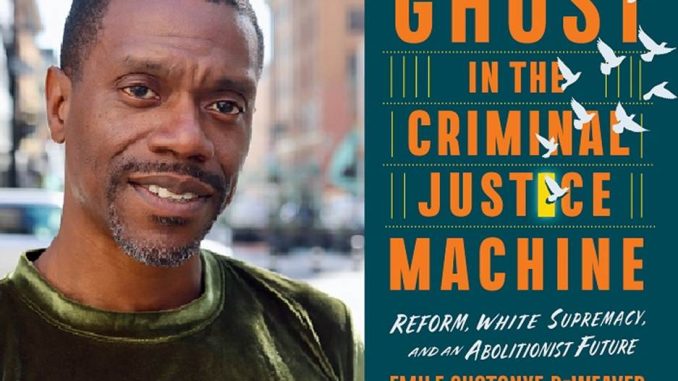
Editor’s Note: The following is an excerpt from Emile Suotonye DeWeaver’s 2025 book, Ghost in the Criminal Justice Machine: Reform, White Supremacy, and an Abolitionist Future.
The political reeducation of Black people became the most important thing in my life after a conversation in prison with a friend. I’ll call him Wes.
Wes invited me into a conversation about a trans friend and activist—whom I’ll call El—who regularly visited me. In prison, taboo attaches to gay, trans, and queer people. Association with them violates a particular code of ethics that allows a respected group of men to enjoy relative safety from assault or challenge. An example of how this code might play out: as long as you pay your debts, don’t steal, don’t talk to the police, regularly shower, keep your cell clean, wake up early, don’t take your boots off during the day (i.e., you’re combat ready), and don’t associate with trans people, you’ll be respected and not harmed.
Wes worried about what my open violation of this code meant for my relative safety.
The entire time Wes was casually denigrating my trans friend, I couldn’t stop imagining El standing there hearing him. I knew El would’ve been deeply hurt. I also knew that they would’ve left the prison with that hurt and still, the next day, put their already endangered body on the line to free Wes from prison.
I struggled with how to disentangle the love at the root of his concern from the white supremacist principles I identified at the root of his position. I’d dedicated my life to Black liberation through prison abolition, and I was talking to a militant Black man who not only cared about me but had his own long history of personal sacrifice for Black liberation.
In that moment, Wes and I didn’t share an understanding of white supremacy or Black liberation.
White supremacy, a three-tiered phenomenon
For me, white supremacy is a three-tiered phenomenon: a power structure built on top of a culture built on top of an ideology. The ideology dehumanizes certain populations and incentivizes stealing power from them to sustain and perpetuate the white power structure. The white power structure is a hierarchy of dominance wherein white men enjoy the top rung and Black people suffer the greatest degradations on the bottom. The culture normalizes this ideology, transmuting it from mere ideology to an erroneous common sense, or natural order, and the power structure enforces it with rewards and punishments through systems and institutions.
Cis-patriarchy is one such system. To normalize white supremacy’s power hierarchy, patriarchy requires a gender binary in family structures wherein men dominate women; relationships that support non-binary genders undermine the so-called common sense of patriarchy and its norming process. Enter transphobia, the ideology that dehumanizes gender nonconforming people as a way to take their power.
Transphobia preserves white supremacy
The reasons vary depending on the person affected, but ultimately transphobia preserves the gender norms on which white supremacy depends. Transphobia is patriarchy is white supremacy, and opposition to these systems paves all roads to Black liberation.
Wes’s analysis of white supremacy is limited by his own personal pain. For him, white supremacy dehumanizes heteronormative people of color to steal their power. That’s true, but it’s only the most visible component in Wes’s life. The normalization of white supremacist ideology remains invisible to him, and he mistakes patriarchy as a pillar of Black families. In this delusion, transphobia protects Black liberation, because in his mind trans culture undermines the centerpiece of any liberation strategy: strong families and communities.
Standing on that prison yard, our hearts breaking for each other, we were simultaneously friends and nemeses.
I imagine his heart broke because he knew me as “solid,” a term that embodies both Black virtue and a history of self-sacrifice to maintain that virtue. My association with a trans person represented for him a crack in that image; the crack indicated an eventual break, which meant another comrade in arms had fallen on the battlefield of Black liberation.
My heart broke because this Black warrior didn’t have a full enough picture of white supremacy to understand that his ideology made him a white supremacist. When I call another Black man a white supremacist, I say so knowing that I too have lived most of my life as an unwitting white supremacist. I say so relying on the distinction author and civil rights activist James Baldwin made between white people and whiteness.
That is, white is not a skin color. It’s “a metaphor for power, and that is simply a way of describing Chase Manhattan Bank.”
Individual approaches can’t solve structural problems
White supremacy is a social, economic, and political order, but it’s also a cultural order. The latter is too often unaddressed or unseen in strategies to end it. Contemporary history bears this out: it hasn’t even been fifty years since freedom fighters discovered that individualist approaches to racism can’t solve a structural problem.
Prison Abolitionists have normalized that discovery in our strategies for change. That’s a victory, but we’re now called to normalize a new realization.
I believe we will fail to end white supremacy if we rely only on structural strategies and analyses, because the structure is only the mechanism of enforcement, not the thing itself. Beneath the structure lies a culture; beneath the culture lies an ideology; and just as individualist solutions can’t answer a structural problem, structural strategies won’t solve cultural and ideological ones.
If we shatter the white power structure, we deny the white supremacists who descended from Europeans the power to operationalize their iteration of world dominance, but if we fail to dismantle the culture at the same time, other contenders remain to take up the legacy. This is why I find James Baldwin’s metaphor of whiteness useful. The marker isn’t skin color but a way of thinking about power—who should have it and how they should use it. It’s also the culture that evolved from the belief in some men’s moral right to subjugate people. I classify anyone who adopts that thinking or perpetuates that culture as a white supremacist because unwittingly or not, they consolidate white power.
This is how a Black activist can be a white supremacist. It’s why I call rehabilitation in prison a white supremacist project—it normalizes false narratives such as personal accountability that seek to justify racism. It’s why I say Christians and the police are, unwitting or not, agents of white supremacy.
These statements may feel too sweeping, but I argue that white supremacy, over millennia, has become sweeping.
Excerpted from Emile Suotonye DeWeaver’s Ghost in the Criminal Justice Machine: Reform, White Supremacy, and an Abolitionist Future. May 2025. The New Press.


Be the first to comment