Nearly one in five charitable donation platforms operating in California have not complied with state registration requirements, an Oakland Voices analysis found.
Donation platforms are meant to make it easy for nonprofit organizations to raise money for causes online. They range from all-in-one platforms that provide donation pages and online processors, peer-to-peer fundraising, to retail or grocery stores where customers can round up their total to donate to a charity.
Although the individual donations may be small, collectively they add up to millions. These funds are supposed to be distributed to the designated charities.
According to the attorney general, as of July 2024, there were over 108,000 nonprofits registered in California. As of June 2022, these charities reported annual revenues of $473 billion with over $1.29 trillion in assets.
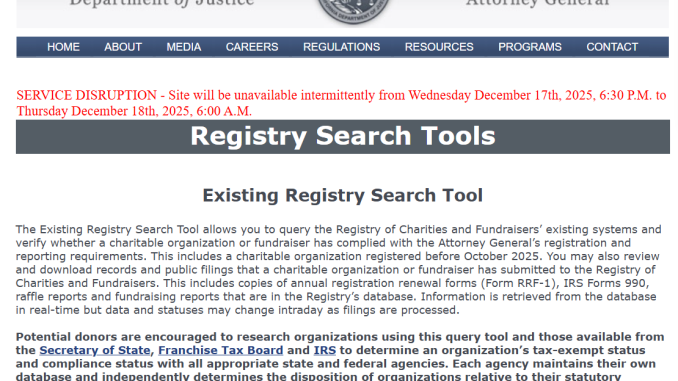
California’s Department of Justice (DOJ) state maintains the Registry of Charities and Fundraisers, a database of nonprofit organizations, fundraisers, and platforms. Each group is subject to different registration requirements and reporting rules. The purpose of the Registry is to help the attorney general’s office oversee charities on behalf of California residents, and ensure transparency and trust in the nonprofit sector.
Nonprofit organizations have long raised concerns about the regulation of charitable fundraising platforms and the Registry.
Donation platforms are ‘most common way’ to give
Geoff Green of the California Association of Nonprofits told Oakland Voices that AB 488, the 2021 donation platform law, emerged due to concerns with platform fees and transparency, whether donations actually reached communities quick enough, and the proper acknowledgement of gifts. These platform companies play a huge role in the nonprofit sector as more individual donations go through online platforms.
“It’s become a huge part of the individual philanthropy world,” Green said. “It’s the most common way now for people to give.”
The state law brought donation platforms like Gofundme, Meta (Facebook), and Paypal under state oversight. It also gave the state jurisdiction over smaller platforms.
On Nov. 12, the attorney general’s office demanded Oakland-based Flipcause shut down for withholding donations and operating without being registered.
But records show that dozens of charitable donation platforms have never registered, allowed their registrations to lapse, or failed to file the required annual reports in compliance with California law.
The California attorney general’s office did not respond to multiple requests for comment for this story.
Most donation platforms have registered with state
The Registry lists 274 charitable fundraising platforms as of Nov. 28, of those 46 are not required to register. There are 31 listed as never registered and 29 as expired. Flipcause is listed as “enforcement action pending.” (See full Methodology below)
Of the remaining 205 platforms, 167 or 81.4% registered with the state. There are 21 platforms with expired registrations, and 16 that never registered–including Flipcause. Altogether, these 37 unregistered companies represent 18% of charitable fundraising platforms.
Those that never registered include Indiegogo, OneCause, Qgiv, iDonate, Snap! Mobile, and Donorbox (Softerware). Bloomerang Fundraising acquired QGiv in 2024, and Bonterra acquired Onecause in October.
Those with expired registrations include Amazon Services, Lyft, and Coca-Cola. Retailers Patagonia, Tumi, and Discount Dance also allowed their registrations to expire.
More than 83 percent of companies filed late registrations
The majority of companies that filed registrations and renewals did so after the deadline. Most companies registered late in 2024: 83% or 158 missed the June 12, 2024 registration deadline. The attorney general’s office indicated they would not penalize companies that registered before Oct. 12, 2024. Seventy-five platforms missed that deadline.
Eighteen organizations did register on time, including platforms Benevity and BlackBaud, Inc., Domino’s Pizza, Paypal, and Mastercard.
Of the organizations that registered in 2024, 141 renewed their registrations in 2025, according to Oakland Voices analysis.
Forty organizations filed their first registrations in 2024 but did not submit the required 2025 registration. In 2025, 25 out of 28 first-time registrations in 2025 were filed late, after the Jan. 15 deadline.
Less than half of the organizations that registered in 2024 also completed their renewal paperwork before the Jan. 15, 2025 deadline either.
Less than half of platforms submitted annual reports
State law requires platforms to file an annual fundraising report (Form PL-4). The attorney general fined Flipcause for not filing these same reports.
Platforms must disclose how much has been raised, the total number of donors, fees charged, and the time taken to distribute donations.
Many annual reports are missing or incomplete; 93 companies failed to submit an annual report.
Among the 112 annual reports received, most are still being processed and less than half were submitted on time. In total:
- 35 complete
- 24 reviewed but deemed incomplete,
- 51 being processed, and
- two submitted by not yet reviewed.
Only 66 platforms – 43 percent – submitted annual reports on time. Twenty-two were submitted late.
Tech companies and all-in-one platforms that did not file annual reports include Apple, Google, Bonterra, Mazlo, and Oakland-based JustFund.
Platforms associated with retailers missing annual reports include Ann Taylor, Forever 21, Rihanna’s Fenty Beauty, Gap, J. Crew, Patagonia Works, and Walmart.
Restauants with donation platforms include Panda Express, Popeyes Louisiana Kitchen, and Toast. Starbucks claimed in its filing that it only began soliciting donations in California in 2025.
In response to a Nov. 2025 public records act request, Deputy Attorney General Kim Kasreliovich told Oakland Voices that missing “reports may be awaiting processing and posting.”
Nearly half of all reports listed in the Registry have neither been reviewed nor posted.
‘They’re literally holding funds hostage’
One platform that met state compliance is Givebutter. In November, Givebutter announced a $1 million relief fund for nonprofits affected by Flipcause.
Givebutter CEO Max Friedman expressed “disappointed by the lack of broader condemnation” of Flipcause’s actions in an interview with Oakland Voices.
“They’re literally holding funds hostage,” Friedman said. “That seems like something that should be stated as not ok.”
Givebutter registered and submitted its annual fundraising report on time. According to the Registry, its annual report is currently “in process.”
He said 80% compliance is “a great start.”
As other states may follow suit to regulate charitable donation platforms, Friedman said he hopes that they align regulations with California for consistency and efficiency.
Friedman did however express concern about the notification requirements placed on platforms and its impact on small nonprofits.
State law requires donation platforms to notify charities if they are out of compliance. This relies on the Registry being accurate.
State charities, platforms Registry is a ‘disaster’
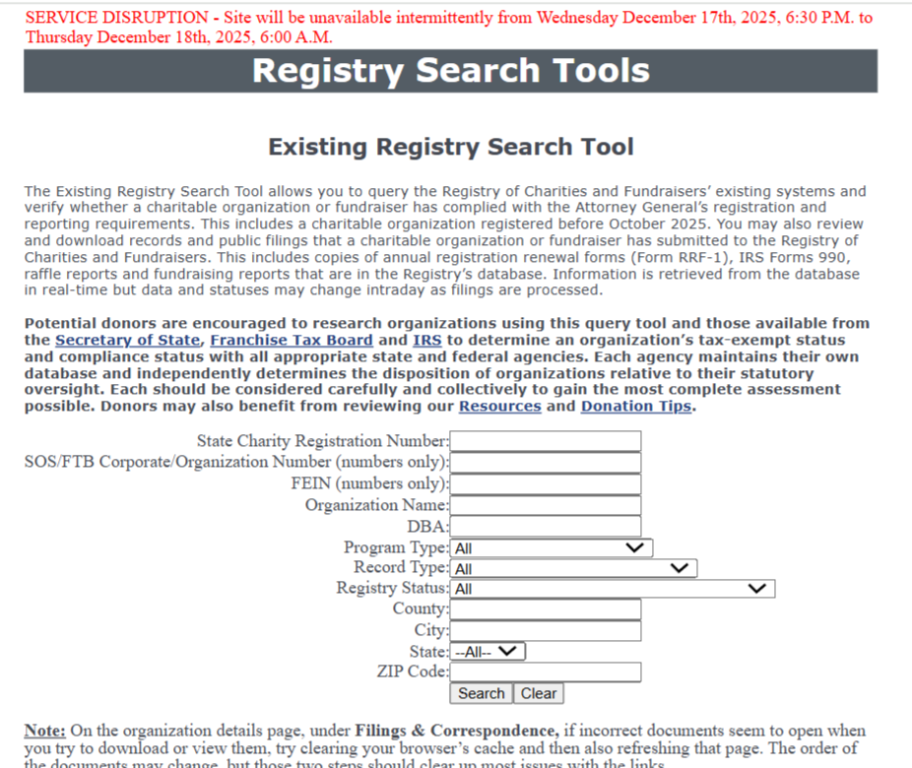
Navigating the Registry isn’t easy. “It’s a disaster,” Green said. “The tool itself is ancient. 1996 called, and it wants its website back.”
A person interested in verifying whether a charity is in compliance must find the Search tool on the attorney general’s website and locate the correct entry.
Flipcause, for example, has two entries in the Registry, a pre-AB 488 designation as a Fundraising Platform, and the more recent listing as a Charitable Fundraising Platform.
The Registry also miscategorizes some organizations and companies. Oakland-based Ujamaa Foundation provides afterschool programming to Oakland youth, but the Registry lists it as a charitable fundraising platform.
“Our situation could’ve been avoided”
During an Aug. 2024 Assembly Select Committee on the Nonprofit Sector, nonprofit leaders testified about the negative impacts of the Registry, the lack of transparency, and need for better communication with the Department of Justice.
On Oct. 22, 2022, the state Department of Social Services informed CocoKids, a childcare referral resource that helps families pay for childcare in Contra Costa County, of its “delinquent” status with the Registry . As a result, the department would not pay the next installment of childcare funds, which would have left childcare providers serving 5,000 families without payment for services.
John Jones, executive director of CocoKids, set out to correct the situation immediately. He found the Registry “challenging” to identify the missing documents. He eventually received an email – without a contact name – identifying what was missing. Jones submitted all the forms and paid the fees. Two weeks later, he was told to complete additional renewal forms, Jones testified.
As the deadline loomed to get continued funding, his calls and emails weren’t returned.
In Jan. 2023, Jones drove to Sacramento to the Department of Justice’s offices. The building was closed to the public. A security guard went upstairs and asked someone to come down. Jones explained his organization’s situation to a staff member in the lobby. They returned upstairs, found the documents, and changed Cocokid’s status the same day.
“Our situation could have been avoided if we had had someone to speak with directly to resolve the situation,” Jones said at the hearing.
DOJ: “We are trying our best”
Department of Justice attorneys from the Charitable Trusts section also testified about modernization efforts and issues with the Registry.
Elizabeth Kim, senior assistant attorney general, described how staff physically processes every document filed by nonprofits to review it for compliance.
“This is why I was encouraging entities to please file sooner,” Kim said. “We are trying our best, given the number of staff we have at the registry and the volume of entities that are operating in California.”
David Eller, registrar of the Registry of Charities and Fundraisers, said, “to prioritize our resources to ensure fairness to all … we process filings in the order that they’re received.”
By contrast, the process for charitable donation platforms has been electronic from the start. Staff said they hoped this transition would help other organizations in California.
“We built a system so that now platforms can register and file all their reports electronically, and we are moving towards all charities being able to do that,” Kim said at the hearing.
While the Registry tool is outdated, a relic of donations and forms being processed solely by paper, the attorney general’s office is “headed in the right direction,” Green told Oakland Voices. He also testified at the Select Committee last year.
The DOJ will replace the “Existing Registry Search Tool” in 2026. All filings will be accessible on the “Early Release Registry Search Tool,” according to the attorney general’s website.
Green and other stakeholders provided input on the tool, but it’s unclear when the transition will be complete.
The attorney general’s office did not respond to emailed questions about the Registry, missing reports, late registrations, enforcement disparities, or staff capacity.
Flipcause fined, ordered to ‘cease and desist’
The Nov. 12 cease and desist order against Flipcause also fined the company for operating without being registered and for not filing annual reports. In total, California fined Flipcause $70,000.
Although the first annual report was due in June 2025, the attorney general fined Flipcause for not filing annual reports for two years. The attorney general’s office has not publicly explained how it assessed penalties for the period before the platform registration requirement took effect. No other company submitted an annual report before 2025.
The order required Flipcause to cease operations, provide an accounting of its assets for the past decade, and transfer all its assets to a blocked bank account by Dec. 12.
It is unclear whether Flipcause has complied with the order or filed an appeal. Flipcause’s website is still online as of Dec. 13. Editor’s Note: Flipcause filed an appeal on Dec. 12.
Methodology
The Registry listed 274 charitable fundraising platforms as of Nov. 30, 2025, including 46 companies listed as “not required to register.” The Registry listed 31 platforms as never registered and 29 as expired. The Registry lists Flipcause under “enforcement action pending.”
Upon review, Oakland Voices removed eight of the companies with expired registrations. We also removed 16 companies listed as non-registered because they did not fit the state’s definition of platforms.
Although OpenTable was listed as not required to register, since the organization recently used its platform to raise funds for victims of the Los Angeles wildfires, we kept it in our database.
The analysis is based on 205 companies listed and vetted as charitable fundraising platforms. These include companies that provide websites and dashboards, peer-to-peer fundraising, or check-out donation options during retail transactions.
Oakland Voices reached out to the Charities Trust Section and the Press Office of California Attorney General Rob Bonta’s office, but they did not respond to questions sent by email and declined an interview request.



Be the first to comment