
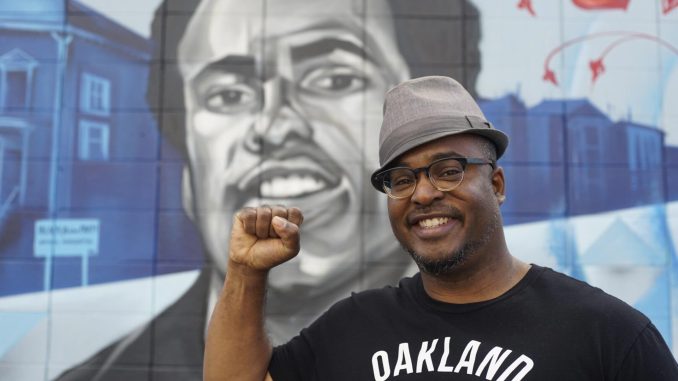
“Refa One,” fondly remembers being a child in the 1970s, riding in the backseat of his father’s Volkswagen as they rode through the East Bay. His father would stop at an intersection, throw his fists out of the window and shout, “Power to the People!”
“The brothers and sisters would do the same,” Refa said. “Our Blackness tied us together. We were together in unity and solidarity.”
Living as a child of Black Panther Party parents that left the organization, but continued its mission, Senay Alkebulan (Dennis) aka Refa 1, 53, carries forward the legacy of the organization his parents joined.
The Black Panther Party For Self-Defense (BPP) was founded in Oakland, California in October 1966. Refa’s parents, Rahn Robert Dennis and Carol Henry, both joined in an earlier formation of the party and had pivotal roles in the organization. Dennis, more commonly known as “Ducho,” was a photographer for the “Black Panther Party Newspaper,” a political educator, and a Minister of Culture.

The Panther of the Black Panther Party
The Black Panther Party For Self-Defense was founded in Oakland, California in October 1966.
Refa One was born Senay Dennis in 1972, one of three sons of Rahn Robert “Ducho” Dennis and Carol Henry. Refa’s parents both joined in the formative years of the party and had pivotal roles in the organization.
Dennis joined the party as a seasoned man, older than most of the leaders of the party by at least a decade. Already politicized and experienced as an activity with the Communist Party and entrenched in Pan-Africanism and the Marcus Garvey Movement, he brought a different set of knowledge and experiences. Dennis, more commonly known as “Ducho,” was a photographer for the “Black Panther Party Newspaper,” and a political educator.
Henry was 10 years younger than Dennis when they met. She collaborated with women in the party and also staffed the party’s newspaper. Like her husband, she was also a political educator –she was one of many speakers at the Black Panther Party National Conference for a United Front Against Fascism at the Oakland Auditorium on July 18, 1969.
A number of factors led members to leave the Black Panther Party. The organization faced threats from the FBI’s COINTELPRO, a counter intelligence program that sought to disrupt subversive organizations.
Leaving the party, but not the movement
The Dennis family went underground along with others in the community. Ducho and Henry, fully aware of their parental duties for three sons, were unwilling to jeopardize their freedom. As a result of an ideological split in the party, Refa’s parents left the party in 1974. They still remained involved with the community and dedicated themselves to activism.
The trauma of leaving the Party, the attacks from the federal government, and the stress of making a living were factors in some former Panthers turning to alcohol and drugs. Henry, however, became entrenched in religion.
“[Religion] was one way to cope with the trauma of leaving the Party,” Refa said. “Mom found much of the personality of the survival programs came out of the Black Church. The love you felt in church was the same energy she carried from the Party,” he said.
The communities in South Berkeley and East Oakland where Refa’s family lived were places where everyone attended school and church together.
“Mothers in the community were the mothers at church,” Refa said. “We lived in a time when any elder in the community could look after you. We knew everyone, we needed each other, and it created accountability.”
Refa said his father stood ten toes down on family. Ducho taught Refa the importance of the family unit and its being organized.
“You have family, community, and the village. If a family is not intact, then everything else falls apart,” Refa said.
When his parents went underground, he lived in South Berkeley and Brookfield Village in East Oakland. Refa recalled gatherings in his home or others’ homes. Musicians, poets, and artists gathered with political thinkers and educators. Ducho would play the flute or the drums. Culture and activism were always in the forefront of this community.

‘I can use beautiful colors to teach political education’
Art was and still is a major part of Refa’s life. Some family members are in the performing arts. His father was a flutist and artist. His mother was a poet and a master calligrapher. She encouraged and taught him art. Henry was an educator at a continuation high school in Berkeley where she also taught calligraphy. Both parents were politicized in their art.
It was no wonder that Refa uses art as a political statement in his teaching graphic design, illustration, and mural painting in the Oakland schools. When asked if he talks to his students about the values of Black Panther Party Refa said,
“I can’t come through the doors with my Panther claws, but I can use beautiful colors to teach political education while we make beautiful art,” Refa said.
Stand firm and ‘Serve the People’

On the corner of Peralta Street and 14th Street stands one of many murals of which Refa One, director of Aerosoul Art, has contributed his mastery in West Oakland and beyond.
On the 14th Street side of Sav-Mor Liquor Store is a Huey P. Newton tribute displaying the vibrant colors and words, imagery, and symbolism created by Refa, his son, Senay Alkebu-lan Jr, and other artists. Among the images is a depiction of the Black Panther symbol, a West African Adinkra symbol, and a man and woman. The words “Serve the People” boldly stands out in red text. There is also an image of the BPP headquarters which was a few blocks away at 1048 Peralta Street.
Initially, the corner store owner did not want a mural.
“When the store owner objected to the idea of a mural on the side of his business, I told him, ‘This is our neighborhood, and we are going to do the mural,’” Refa recalled.
I recently asked the owner’s son, Mustafa, how he felt about the mural.
“It’s cool,” he said. “You have to represent.”
Refa stands firm when it comes to his beliefs on ownership and territory and as a leader in his community. Refa has communicated with other local business owners that, despite the changing demographics of West Oakland, the Black Panther Party legacy still prevails and will be respected.
The son of a Panther Cub
He impressed these principles upon his son, Senay Alkebu-lan.
Growing up with revolutionary parents, Alkebu-lan, 29, espoused his parents’ philosophy.
He attended African-centered schools, including Ile Omode School through middle school, which he credits as a big influence in his life.
“I was taught to honor African people, and I chose to do so,” the younger Alkebu-lan said. “There was a great deal of academic rigor, and we learned African history. The education I got is a big part of how I am able to carry what I carry and know what I know.”
Alkebu-lan is expressing his own visions for the future while paying homage to Oakland’s Black Panther history through fashion and music with Futurisme Studios.
Refa One: Being a child of a Panther is not the same as being a Panther Cub
Refa is also resolute on the purpose of a Panther Cub, a moniker used to describe the children of Black Panther Party members. Not everyone with Panther parents are cubs, according to Refa.
Although the Dennis family left the Black Panther Party early, they never abandoned its ideals and objectives. Ducho Dennis came to the party with maturity, prior activism, and a revolutionary spirit. He set high standards and expectations that his family never abandoned. They carry on the mission and legacy and have dedicated a website to Ducho Dennis which is chronicling their family history and activism.
“I do make a distinction between a child of a Panther and being a Panther Cub,” Refa said. “I believe being a Cub, you carry the mantle and continue doing the work. If that is not the case, then you just had parents who were Panthers, Until our people are free, the fight is not over.”
Editor’s note: This story is the second in Dera R. Williams’ series on Panther Cubs. This story and series is funded by the East Bay Fund for Artists 2 grant from the East Bay Community Foundation.
So Proud of my family and all they accomplished and still continue on to this day!!!
One Love