
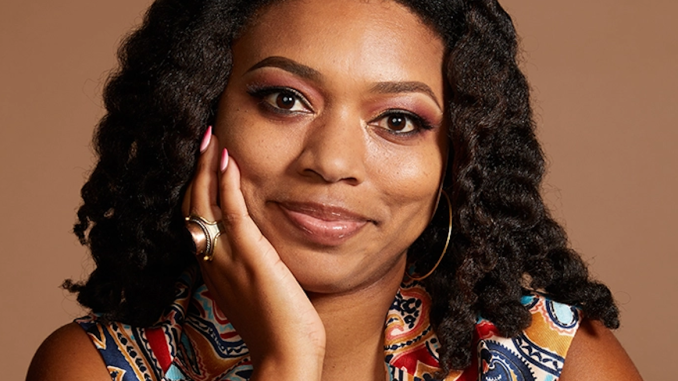
Filmmaker Nijla Mu’min’s love for poetry, photography, and dance led her to filmmaking. Growing up in the Bay Area, she developed a grassroots approach to storytelling, creating films that embed issues of social justice and challenge stereotypes.
Her debut feature film, “Jinn” premiered at South by Southwest Film Festival in 2018. The coming of age story focuses on a Black teenage girl navigating her mother’s conversion to Islam. Her director credits also include episodes of “Queen Sugar” (2018), “Insecure” (2020), and “Wu-Tang: An American Saga,” She’s currently raising money for her newest short film, “Noor,” an interracial love story about a Black woman and a Palestinian man. Noor is Arabic for light.
Oakland Voices caught up with Mu’min, fresh from Atlanta where she directed an episode of Hulu’s “Reasonable Doubt.” She talks about her journey as a filmmaker, the evolution of the script for “Noor,” and her upcoming projects.
Editor’s note: The interview has been edited for brevity.
Getting started in filmmaking
How did you get your start in filmmaking?
Nijla: I became interested in filmmaking when I was a young college student at UC Berkeley. There, I was heavily immersed in writing poetry. As part of June Jordan’s Poetry for the People, I taught and studied different poetic traditions from across the world by Black and brown poets. That was a big influence on who I would become as a writer and as a filmmaker. In a film photography class, I would go out, take pictures of everyday life around Oakland, Berkeley, and El Cerrito. I started chronicling life into these photo essays and photo stories.
The combination of photography and poetry led me to filmmaking. I was also an avid reader. I loved reading books, Black contemporary fiction. It was all of those influences, as well as music and dance, that came together to influence my entrance into filmmaking. I wanted to go a step further and merge all of my artistic passions into one medium.
I felt like cinema was a place where I could really bring storytelling, visual storytelling, photography, and fiction together. I started saying, “I want to be a director.” I spoke it in existence. I started to develop my craft, make short films, take classes, and then I went to film school.
Independent filmmaking, from the Bay
Oakland and the Bay Area is home. How has the Town and the Bay influenced the stories you tell and your approach to storytelling?
Nijla: Growing up in the Bay Area really gave me this grassroots approach to storytelling. I didn’t encounter barriers exploring my creative passions. I came from an environment here in the Bay where I saw people who were very passionate and deeply involved in activism. When they wanted to do something, they just did it. The spirit of the Black Panthers, the Nation at Islam, organizations in the Bay that were very grassroots, that were deeply entrenched in the community and didn’t wait for bigger entities or figures to give them permission to act.
I always followed that type of ethos of community action. When I wanted to make my first short film in Oakland, it was like, “I’m just going to make it. I don’t have to wait for my school or for Hollywood or for anyone to tell me I can do it.” I shot it on the street corner in North Oakland where I lived. The thinking was: I’m going to be outside in my community. I’m going to recruit people from my community at school to be a part of it and we’re going to screen it for the people who want to see it, right? Like there was no waiting or asking for permission. It was like, we’re just going to do this. And I think that’s a big part of the Bay Area culture and especially the artistic culture in the Bay is that people just are doing it from the ground up, grassroots, collective action.
When it comes to the arts, no one is being pretentious or acting like they’re better than anyone. We’re just out here grinding, doing our thing. So I think that approach of just reaching into the community, doing what you want to do and getting it done is something that I definitely inherited from growing up in the Bay Area. Community art and making something that you feel passionate about that also speaks to social justice issues, that also pushes themes of humanity, seeing people beyond the profile and the stereotype that is attached to them by law enforcement, by government entities.
Those were early themes in a lot of my work. It was about seeing people beyond how society sees them, seeing them in a complicated light, seeing them as human beings. And I really feel like that came from the Bay Area, and the social justice background of breaking down and subverting harmful ideologies through image making.
“Noor” is a love story that I started writing about 15 years ago. It is a feature film about a Black woman named Noor and a Palestinian man named Rami who meet in the Brooklyn neighborhood bodega where he works. They form a close bond after a tragedy occurs near the bodega and through their relationship, they really help each other to heal.
Nijla Mu’min
Another way the Town has influenced you may be your hustle. You are currently raising funds to complete Noor, your most recent film. Tell us about the film.
Nijla: “Noor” is a love story that I started writing about 15 years ago. It is a feature film about a Black woman named Noor and a Palestinian man named Rami who meet in the Brooklyn neighborhood bodega where he works. They form a close bond after a tragedy occurs near the bodega and through their relationship, they really help each other to heal. They’re very passionate. It’s a love born out of a very unfortunate situation, but it’s also a love that subverts a lot of the division and hatred in the society at that moment. So it is an interracial, multicultural love story, with very high stakes.
It’s been a very long journey trying to get the feature film made. The film has won many awards. It has been through screenwriting programs. It’s gotten a lot of grants. This story is so relevant to the time that we’re living in. It’s about empathy and compassion across cultures. And it’s a story that is about love. But it’s also about two groups of people who have been so deeply and routinely disenfranchised in a global sense. A Black women and someone who is Palestinian come together to love each other. It’s a very important message that we need right now as we see communities of color really struggling to survive in the world.
I made a short film version of the feature script last summer. We recently completed the short film, including the post-production. We had a fundraiser where I was raising money to complete post- production, including sound, color correction, and the music. I raised almost $30,000 for the film through the fundraiser, and two other grants, which I’m very grateful for. So the journey is not over.
We had a packed house for a screening of the film in Los Angeles. It was amazing. People were so moved by the film. I’m still looking for a way to get the feature film made. That’s the ultimate goal. To get it out into the world. Even though it’s set in Brooklyn, it’s an international film in terms of its subject matter and the themes that it addresses.

Fifteen years of ‘Noor’
This film is 15 years in the making. Tell us about the journey and your experience as an independent filmmaker.
Nijla: It’s been a 15 year process of trying to push this forward. At one time, I thought that this film was going to be my first feature film because I had gotten the script through the Sundance screenwriters intensive. I won a best screenplay award from Urbaworld in 2014 and I had a high-profile actress attached. I had a crowdfunding campaign that we were about to launch. Unfortunately, I ran into a very scary scenario where I lost the script because I signed a bad option agreement with someone I was working with. Then had a falling out with them.
That halted the movement of this project at that time in 2014/2015. It’s an an artist’s worst nightmare to have your heart and soul taken from you, but there was nothing I could do. I had a lawyer. All I could do was to honor that option agreement. I had to write something new, and I ended up writing what would become my first feature film, “Jinn,” which is a Muslim coming of age story about a Black girl falling in love and trying to make sense of her identity.
Out of the pain of having to separate from “Noor” for that time, I had to write something new and I had to move on. I didn’t forget about Noor. Once that option agreement ended, I continued on trying to get it made. The script and the story have been through many revisions and iterations. I’ve done a lot of research. There was one time where I was just researching Black and Arab romantic relationships in real life so I could bring that into the story. I also did a deep dive into Palestinian cinema in order to use that as an influence in the story. It’s been an emotional roller coaster with this project, but I really feel like we will see it through and it will be made, Insh’Allah (God willing). This project is very special to me.
You started this film at a particular point in your life and are completing it as another. How has the story changed and remained the same as you have moved and grown as a filmmaker and woman?
Nijla: When you have a story that you’ve been with for 15 years, it’s going to change a lot as you grow as a person, as an adult, and as a woman. It’s going to go through a lot of revisions and the script for “Noor” has definitely changed and transformed over time. But at its core, it’s always been about the love and the passion between Noor and Rami. Earlier drafts focused a lot on the courtroom experiences of Noor and her family after the police brutality tragedy they endured. Later drafts focused on the inner emotional journey of grief, love, and healing in the wake of the tragedy.
The way that I envision love has changed over time. When I was in my early 20s, my idea of love and romance was a little different than now. When I was younger, I focused on the passion, the excitement, and the attraction. Now I know love is about showing up and being present for someone through the best and worst times, holding space for another, and being a consistent partner over time. Love is action. It’s a reciprocal exchange and should not feel one-sided.
Nijla Mu’min
Also, the way that I envision love has changed over time. When I was in my early 20s, my idea of love and romance was a little different than now. When I was younger, I focused on the passion, the excitement, and the attraction. Now I know love is about showing up and being present for someone through the best and worst times, holding space for another, and being a consistent partner over time. Love is action. It’s a reciprocal exchange and should not feel one-sided. I used to think I had to fight for love, prove my worth, and go through the pain, but I’m not interested in that anymore. As a storyteller, you just start to kind of have these different interpretations and these experiences in your own life that then impact how you see your characters.
I started writing this film in 2010. Now we’re in 2025. A lot of time has passed. Society has changed dramatically in those years. When I look back at some of the early drafts, some of the story it feels like it’s another world. There was no pandemic. Social media wasn’t as big as it is now. Like people still had a house phone – well at least some people did. Life was not what it is today. What is beautiful about this script is that it still contains some of the elements of the earlier drafts, but it also is a current story about cross-cultural solidarity. It will remain that way. I think the beauty is that when you’re creating before this time, you have a kind of purity to your storytelling because it’s not affected by what is happening right now.
Nijla Mu’min’s upcoming events and projects
Last month you premiered Noor in Los Angeles and you had a screening in Redwood City at Bravemaker Film Festival. Any Oakland premiere planned for Noor?
Nijla: Yes. We are having Oakland screening on August 14th at Oakstop. It’s a part of a series, “Black film Unscreened and Unstreamed: Creating Space” put on by the Sarah Webster Fabio Center for Social Justice. We’ll be seeing “Noor” and all of my feature film, “Jinn” (2018).
What are you currently working on or working on next?
Nijla: I’m taking a break. I’ve been doing a lot this year from fundraising and completing the “Noor” short film, to another project I wrote and directed called “Water Angel” about Black maternal health and a Black pregnant woman who is fighting the medical system to be heard. That short film comes out this August and on Paramount Plus and YouTube. And I just directed an episode of a television show called “Reasonable Doubt” on Hulu. I’m currently in my director’s cut edit for that now.
Aside from that, I’m really at a space in my life where I’m trying to figure out what is the best way forward for me. There’s a lot of exploration right now. I’m coming up with an idea for a new feature script that I really want to write. And I have another film script called “Mosswood Park,” a love story about two young artists who meet at Mosswood Park Summer camp in Oakland when they’re kids and have this really deep relationship and bond throughout their lives into adulthood. And it’s an East Bay, Oakland Black love story. It’s really based on my experiences growing up in the Bay, my first love, my love of cinema and being an artist and the kind of ties that bind us to other people. That’s a film I’ve been trying to make for many years as well. Hopefully that one will be up next.
Do you have any advice to aspiring filmmakers in Oakland?
Nijla: It’s really important to have a deeper purpose behind your filmmaking because it can get really challenging, especially in our current environment, to make anything. Whatever you’re trying to do, it’s just very important to know why you’re doing it. “Why am I telling these stories? What does this story mean? What type of implications does this story have on people?”
There’s a lot of movies that are just for entertainment, for fun. But I think the movies that we remember, the movies that people are still talking about after they get out of the theater or two to three years later, are the ones that have that deeper meaning, that made the audience feel something and think something that they can’t shake or they can’t forget. Those are the films that people remember and that they continue to preserve and talk about.
Any young filmmaker, any aspiring filmmaker, storyteller, writer, director, cinematographer, should have some kind of purpose, a purpose bigger than themself. And that will really reflect in the story and distinguish the story from so many different movies that are made every day. It’s very important.
Where can people follow your work or get updates?
Nijla: People can follow me on Instagram. My username is my first name, @Nijla1. Much love!
Clarification: This article originally implied Mu’min was born in Oakland. She was born in Berkeley, and lived in Oakland and Hayward.


Be the first to comment