
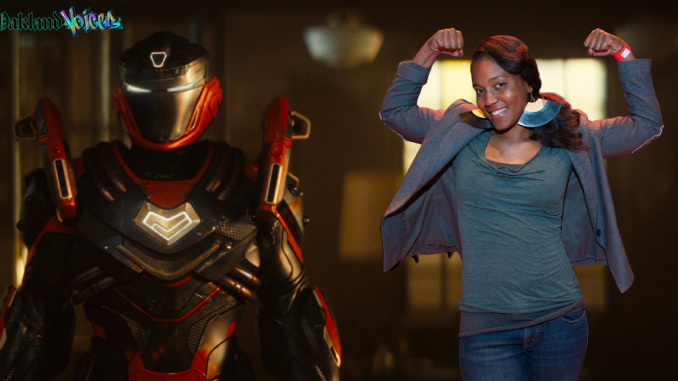
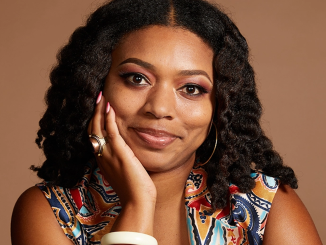
One of Oakland’s sharpest wordsmiths to wield a pen, Chinaka Hodge, premiered the new miniseries “Ironheart” on Disney+ June 24. The show centers on Riri Williams, a super genius from the South Side of Chicago that many of us first met, on screen in the Marvel Cinematic Universe (MCU), in “Black Panther: Wakanda Forever.”
As Ironheart’s Head Writer, Hodge convened and led a team of writers to develop and fine tune the show’s script. Conceived shortly after the birth of her own daughter, Aziza, the six-episode series follows Riri’s journey back home in The Chi after the events of Wakanda Forever. The series is mystical but features Chicago realism and shows the perils of navigating trauma amid promise and possibility.
Ironclad when it comes to Oakland, the poet and playwright’s catalog includes her book, Dated Emcees (2010), and the play, Chasing Mehserle (2014). Now she’s poured her heart and magic into the MCU.
I caught up with Chinaka in Leimert Park, Los Angeles. In an exclusive interview with Oakland Voices, we talked about her journey as a writer, her lifelong connections between Oakland and Chicago, and the series that she’s spent the last five years creating, Ironheart.
Editor’s note: The interview has been edited for brevity.
From poet to film writer
Rasheed Shabazz: Some of us know you as a poet. How did you get started with TV and film writing?
Chinaka Hodge: I think it was a pretty natural progression from poetry. I had a strong urge to begin arguing with myself within a slam poem. Someone was like, “That’s a play.” I did my first play with and around Campo Santo and Intersection for the Arts, and sort of satisfied that ambition. I thought, “That was great, but I wish we would’ve recorded it and more people could have seen it.” Someone said, “That’s television.” My transition to TV was natural. It wasn’t, “I quit poetry and now I’m gonna go write film.” It was, “How do I bring my best skill set, the things that I’ve learned in poetry and prose, and take it to screenwriting?”
I went to USC and did the concentration in Screenwriting at the School of Cinematic Arts and happened to be there at the same time as Stephen Caple (Jr.), Katrelle Kindred, and Ryan Coogler. I began to pay my dues and cut my teeth by working on everybody else’s student films. I used to follow Ryan around campus and just say, “Hire me. Hire me. Hire me.” The first thing we worked on was about young people in the juvenile justice system who often don’t get a fair shake, who often don’t get a chance to externalize their brilliance. While that project never got off the ground the way we imagined, we took a lot of those same ideals in Ironheart.
Rasheed: What’s the difference when you’re writing poems, a play, and now writing for TV?
Chinaka: The level of collaboration makes it that much harder and that much more of a trust exercise. When it’s 1000 people working on it, it’s much more of an almost sacred act than if one person is in agreement on it. For better or worse, I crave the collaboration. My craft has gotten so much better. My poetry has gotten so much better and sharper. I think differently about people’s time. I have a different conception after working in TV. Three minutes of TV is so much money. Three minutes of listening is so much time. That’s the sort of standard we give poets and give a scene. So I want to make it as full as possible for the people giving their attention.
Head Writer and the Writer’s Room
Rasheed: How did you come to be Head Writer for Ironheart?
Chinaka: I worked on a different pitch for a different project that wasn’t a good fit for me. I’d pitched a really strong, very action-heavy female protagonist for that movie as kind of a side character. I took them saying, “No, not right now” as a big fail. Ultimately it was actually a big success, because what I was pitching was much more closely aligned with Ironheart than that project.
I joke that I pitched on Ironheart from the hospital bed, but it’s pretty close. I remember introducing Aziza, my child, to my creative exec within like a week or so of bringing her home from the hospital. After I’d reached the third round of pitching on Ironheart, I found out that Proximity Media was involved, and was really delighted to be working with my longtime friend and collaborator, Ryan Coogler, and Sev Ohanian and Zinzi Evans Coogler. We’ve been wanting to work together in a big way for so long. I was working on everybody’s student films back in the day. We’d all been in communication and collaborative partners and friends for a really long time, so I felt that much more pressure to get it right. It’s different when it’s when it’s your homies and people you respect at the table.
I don’t think I can tell a story without talking about Oakland. There’s definitely a scene in this show, set in Chicago, where the two characters who are both Chicagoans, go “Bruh. Bruh. Bruh.” Apparently I can’t keep Oakland out. But Oakland and Chicago have always been sister cities in so many ways.
Rasheed Shabazz: What does a Head Writer do?
I got the joy and pleasure of building my own writers room for the first time, which is something I’ve worked a really long time for. One of the first tasks of a head writer is to figure out who else is going to collaborate. What are my deficits? And how can I fill those deficits with the best minds possible?
So the homie, poet Amir Sulaiman, had just come off of Emmy win on Ramy, was a very natural fit. Malarie Howard wrote a script about mental health and Black women in a technological space. She’s just younger than I am and a much better writer than I am. I got to learn from her and soak up her game. I got to hire a sister team in Fran(sceca) and Jackie (Jacqueline) Gales, who had worked on a different Marvel show, a legal drama procedural, She Hulk. Christian Martinez just loves to do action writing. Then we brought on the writers room assistant of the century, Nicole Desperito, who worked so hard and gave so much that she gets to live in the MCU forever, as her name is one of the names of the hangouts in our show.
We led a writing room workshop on character, story arc, breaking it down into episodes. Then I assigned episodes out to each of the writers. Each writer wrote their own episodes. Our room ended and I kept on with all of the scripts. The writers wrote the backbone of the script, I then had the pleasure of touching it along the way, getting feedback from the folks at Marvel and Proximity.
Most head writers get a choice about going to set or not. I love it. I can’t help but be in there. I got to affect and touch a whole lot of decisions that I felt really, really special and blessed to be able to affect.
About Ironheart
Rasheed: What can you tell us about Ironheart?
Chinaka: Ironheart is a six part television series for Disney, but it feels like film in so many ways. That’s what Marvel brings to the table. It’s a big, cinematic experience, a full universe inside of every single thing that they bring.
Rasheed: Tell us about this story, this character in Chicago, dealing with these issues.
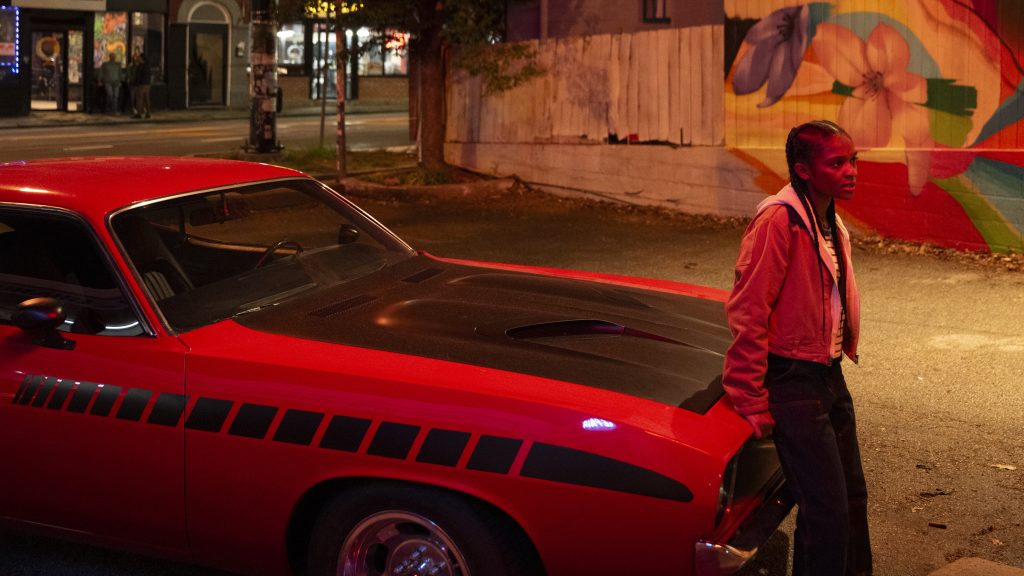
Chinaka: Ironheart is a story of a 19-year-old super genius from the city of Chicago, South Side to be specific, who builds her own iron suit with her ingenuity. She’s a scientist you met in Wakanda Forever. But this is her story. It’s not so much an origin story. It’s just sort of an introduction to Riri and her grounded, day-to-day existence in Chicago.
We did our very best to bring in as much Chicago realism as possible, from hiring some of the best Chicago actors, from young Harper Anthony, who’s making his Marvel Cinematic Universe (MCU) debut; Shea Couleé, who’s from Chicago, right up front and center; Anji White playing Ronnie, who’s Riri’s Mom.
Riri literally can write code, she can read code, and she can also code switch. Everybody in the show does as well.
We have some really iconic Chicago locations. And while we were shooting in Atlanta, I think one of my favorite Chicago realism moments was bringing in Saba from Pivot Gang, who’s one of my favorite rappers from Chicago, to come in and do a full set. One band member is actually from Oakland. It was a family reunion.
You don’t really gotta care about Black Girls in Tech to care about what’s going on in some of the elements of the show. You just have to like fun. You have to like Marvel. I think there’s a little bit of everything for everybody in the show.
We explore themes of STEM in a really fun way for the comic book audience. Riri’s story is fun. It’s grounded in so many ways and then hyper-real in the spots you want it to be. Hyper realistic. It’s prismatic in that it presents America like the one I know: full of people making very hard decisions with limited resources, people who are immigrants, queer, brown, mixed race, scientists and people who believe in science, are all often under attack. It’s a fun show that talks about real issues, real timely issues.
The Oakland Influence
Rasheed: How has Oakland influenced your storytelling?
Chinaka: I don’t think I can tell a story without talking about Oakland. There’s definitely a scene in this show, set in Chicago, where the two characters who are both Chicagoans, go “Bruh. Bruh. Bruh.” Apparently I can’t keep Oakland out. But Oakland and Chicago have always been sister cities in so many ways. My mother is actually from Illinois. She grew up just south of the city. She’s a technologist as well. She met my stepfather, who’s also a technologist, at Northwestern. My father also went to Northwestern. I spent plenty of time in Chicago growing up.
The influences my parents wanted me around in California were the same kinds of influences they wanted me around in Illinois. It didn’t change just because the location changed. I think about Marcus Books in the Bay, I think about Eso Won in LA, and I think about being around brother Haki Madhubuti in Third World Press. Oakland influenced me plenty. Let’s not get it twisted. *West Oakland accent* But Chicago was also always in the bloodline, always in the sauce.
Coding and code-switching
Rasheed: I don’t know how that accent you just shared with us will translate into writing, but I’m grateful I got to experience that live.
Chinaka: That’s one of the pure pleasures. There’s both a code switch and a legibility without the code switch in our series. Riri literally can write code, she can read code, and she can also code switch. Everybody in the show does as well. So does Shea Coulee’s character, who’s actually our hacker/code writer. If you’re a Marvel fan, there’s all kinds of fun. You don’t really gotta care about Black Girls in Tech to care about what’s going on in some of the elements of the show. You just have to like fun and like Marvel. I think there’s a little bit of everything for everybody in the show.
Motherhood, a superhero story
Rasheed.: You mentioned giving birth to this film, shortly after giving birth to your daughter (Aziza). What is it like being a Black woman, with a Black daughter, writing a series about a Black girl that’s a superhero?
Chinaka: Aziza is the superhero. Everything else is just the approximation. Aziza was in the writer’s room with me pretty much the whole way through. She wasn’t allowed on set because we were in Covid protocol, but she came as close and as often as she could. She definitely weighed in.
I showed her the (film) trailer, and she looked at it. “Mom, you said this was for kids. This isn’t.” The next charge is to make an animated something, a young Avengers, or something that she can hold.
But there’s a face mask that features prominently. *holds up Riri’s mask* It’s a portion of Riri’s suit that she loses in the intro segment of the first episode. Aziza found it in the house not too long ago and put it on for the first time. She went around wearing it, saying she was Ironheart. That’s the biggest win, to have my kid pretend to be the action hero that I spent time away from her creating is the best, probably undeserving, gift.
It’s hard to write a futuristic world without considering all of the pioneers of Afrofuturism, but I was also heavily influenced by Chicago poets, the Gwendolyn Brooks’, the Commons. I wanted to make Riri feel like someone who could be hanging out with a Jamila Woods, a Jean Deaux, Wasilu Muhammad Jaco (Lupe Fiasco), or Bisa Butler, or any number of my favorite Chicago heroines.
Chinaka Hodge
Ironheart inspirations and world-building
Rasheed: You built a world. I’m curious about what inspired you. What were your inspirations for building this world for Ironheart?
Chinaka: I built the world, but a grounded world in Chicago. I can’t wait for you to watch, to see the apertures we’ve made in and around the very ground in Chicago, into the other locales within the MCU. One of the great things about working within and around Marvel is they have an expert for everything. One of our creative executives, Kelsey Lew, just has encyclopedic knowledge of all the characters, the MCU, and brought amazing suggestions about characters that might have been under serviced or might have interesting through lines that we hadn’t picked up on yet. Same thing for the props department or visual development, sound effects, visual effects. Everybody is top tier there. No slouches.
I was less influenced by Octavia Butler on this than I would say most projects, just because there was a source material in both the Brian Michael Bendis as well as Eve Ewing’s runs. Eve, you know, as a poet, took the character that Bendis had created, and gave her a moniker in Ironheart, and really infused a sense of self and politic into the writing in its own way. My job was to get that part right, to take the themes, the stories, the attitudes that Riri has, and translate those to screen.
It’s hard to write a futuristic world without considering all of the pioneers of Afrofuturism, but I was also heavily influenced by Chicago poets, the Gwendolyn Brooks’, the Commons. I wanted to make Riri feel like someone who could be hanging out with a Jamila Woods, a Jean Deaux, Wasilu Muhammad Jaco (Lupe Fiasco), or Bisa Butler, or any number of my favorite Chicago heroines. Dominique’s (Thorne’s) existing character, and Judas and the Black Messiah, that are already being set in the city of Chicago, and how we could sort of pick up some of that through line. It’s less external because I had so much fodder to pull from. It’s a whole universe, for real.
Freestyles and words of wisdom
Rasheed: You mentioned this transition/non-transition shift from poetry. You still have flows? You still have bars since you’re writing for TV now?
Chinaka: I just saw Leroyce Hawkins, who plays Gary in our show, on Sway in the Morning. Part of me was like, “Man, I wish I had Riri bars for Sway right now.” I sat down to start writing some before this interview. I still got flows, but I no longer freestyle. That’s what I learned post- MCU: Style for fee.
Make what you see in your head now. Don’t wait for anybody’s permission. We have all the tools.
Chinaka Hodge
Rasheed: Do you have any words of wisdom or inspiration for aspiring filmmakers or writers?
Chinaka: Make what you see in your head now. Don’t wait for anybody’s permission. We have all the tools. Whatever camera you have in front of you is pretty great right now. Whatever script writing software you have right now is pretty great. No time like the present to make a proof of concept.
Rasheed: Where could people follow your work and get updates about what you’re working on?
Chinaka: Follow my work? Disney, plus, streaming six episodes. I’ve been working on Ironheart for the last five years, my guy. I’m working on other projects right now, but if you want to see the thing that I’ve poured the most into, six episodes, streaming now. The more people watch, the more choice I’ll have about what I get to make next.
Ironheart has six episodes streaming on Disney+..


Be the first to comment