

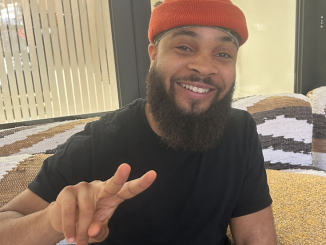
Louis Keyamo Johnson, III is a scientist, CEO, and educational coach doing his part to shift the cultural landscape for Black students and entrepreneurs in the City of Oakland. Through his non-profit Unique Natives Interacting Together Elevating (UNITE) and programs he spearheads in coordination with Black on Broadway, Mr. Johnson and his partners are working to build a Black business district in the Town, starting with a string of shops, restaurants and office spaces south of the Fox Theater, spanning down to Latham Square.
I visited the brother at UNITE’s office space in Oakstop, a Black man-owned business coworking and event space with several locations along the Broadway corridor. We discussed his philosophies on education, Black business, and cooperative economics. This interview has been edited for brevity and context.
You mentioned that you were born and raised in Vallejo. How is Oakland different from your hometown?
I would say there’s many differences, and also many similarities. One of the biggest differences is the size of Oakland. It’s very big. In my time being here, I see that Oakland has many different personalities in different parts. Even though in my city we have Northside, Southside, everything in between is kind of mixed; out here I hear a lot of people from different sides really representing those sides.
I would also say the community in Vallejo, we have a lot of history with each other. It’s very small and so a lot of things are very personal. That translates to business, sports, schools, and a lot of places. Out here in Oakland, I feel overall the community has been much more supportive. I still see certain groups who grew up together and have their own pockets of support, but I do see a lot more support here, whether that be from the homeless community, the Latino community, from let’s say a conscious community, they have the bike riders, and it brings a lot of people from a lot of different places to have that cultural gumbo. It’s similar to Vallejo but I feel like it’s much more potent here in Oakland.
Can you tell me a little bit about the mission and your work with UNITE?
The name UNITE, is an acronym in itself: Unique Natives Interacting Together Elevating. That tells a little bit about it, but our mission is to get people to understand and see that we all can work together and have an eclectic community. Right now our focus is education. Most of the people I work with are in the STEM fields (Science, Technology, Engineering, and Mathematics). Right now, what we’re implementing is STEAM education (Science, Technology, Engineering, Art and Mathematics). We added the art in there, because something I learned in Vallejo is that Black people—or melanated people—we’re very creative. That’s something that helped me through my path of science, was being able to use creativity. Right now our focus is STEAM education with the youth, but the overall mission is to promote connectivity, community and collaboration. Right now we’re facilitating that through education, and some community events as well.
Can you speak to the importance of education, learning and—a word you used earlier—unlearning for Black people?
The history that’s promoted in our education to us—ironically—is that we weren’t given education in the beginning of our history in this nation. That was something that our ancestors had to fight for, and in that process there was a loss of the education we were already teaching, or let’s say our culture. I feel like this term “education” is something fairly new to the world. We have always been learning. Learning, and teaching, et cetera.
For example, in my astronomy class, they spoke about the Dogon people. They have celebrations and ceremonies. They’re dancing, but they’re celebrating the orbit of [the star] Sirius. They’re saying it’s a ceremony, but I’m like “How come that can’t be a lesson, or a class? Just because people aren’t sitting down or taking in a sermon like in Catholic school?” That, to me, is still learning. Even more so for UNITE: we believe that the curriculum is life, and the classroom is the world, so we’re always learning. What we need to learn is how to live. The importance of it was shown in where we’re at today.
Another example from my own experience: I was at Prince University at a Black mixer with all these people who had masters [degrees] and PhDs. I was happy to be with all these dope people and I had my own business, an LLC at the time. I was asking what they all want to do, and I was trying to see how we could work together. A lot of them said “Oh, I want to work at Facebook”, or “I want to work at LinkedIn” or “I want to work at Amazon.” And there’s nothing wrong with working at these places or doing these things, but in my mind, I believed that this was the cream of the crop, and the best of the best. All these people they’re working for were in their position, and dropped out of school to create these Fortune 500 businesses. I’m like “We’re in the perfect opportunity to do that same thing.”
So the importance of education to me is for us to get our awareness of who we really are, and get our power back.
You said you switched STEM for STEAM, and added the A. If it’s possible, which types, or fields of education do you find to be the most important for us?
[At UNITE] we call our curriculum Afrocentric curriculum. The basis of what that means is that we don’t believe in the subjects [in the Western traditional sense]. So I’m not going to use the context of what they say we should learn, but the title of what I believe currently is important is Knowledge of Self, or our own history.
For example, in my own personal journey. Like we said, I’m Louis Johnson III, and talking to my father and his father, [even though] we had vastly different experiences, the journey and our connection with God, and those conversations that we’ve had internally. It was so similar that I’m like “Bro, this is crazy. Why are we not learning about this? This connection that we have with all the people around us, and this information they have that they can give us.”
You do a lot of work with Black on Broadway. What’s it been like working in coalition with other Black owned businesses?
Man. It’s a blessing and an honor. A quote that I heard from Marshawn Lynch—I don’t know who was the first one to say it —but he said “If you want to go fast, go alone, but if you want to go farther, go together.” That really resonated deeper [to me] when he said it his way, but that goes back to Ubuntu principle (“I am because we are”).
Working together is an honor because in academia it’s very competitive. Everything is about “Don’t look at my work.” or “Don’t look at the things I’m doing.”, even if it’s beneficial to academia-at-large. Finding people to work with that you resonate with, or share the same morals and values with, was very hard for me in academia. So being out here in the real world, where it’s also seen as dog-eat-dog, it’s beautiful to work with like-minded individuals who are business owners with their own missions and visions that align together.
You’re very collaborative in your work with other businesses. Do principles of cooperative governance or collective economics play into your business relationships?
It starts from the beginning. A lot of this was inspired by my time studying, when I was a part of the Banneker Institute at Harvard University. In my time there, I learned about Ubuntu principles, and even certain Afrikan economic systems such as Susu. When I learned about those as opposed to capitalism, I was really passionate about it, and learning about business, I saw that as a way to implement these concepts to a greater audience. So like I say, it’s the basis of everything that we do.
If we work together, it may not come right now in terms of finance that everybody’s giving, but I’m believing that if we put this in right now, we’ll get the blessings in the future throughout the month, and that’s why we do it on a monthly basis. Even tutoring for our Saturday school. All throughout this year, we’ve offered tutoring free to the community. And I’m saying the word “free” because there’s no money exchanged, but I’m not trying to disrespect the exchange I was getting from the people. The parents and children there, it was an honor to work with these geniuses. It was an exchange that was more valuable than money.
Another thing that we’d like to do, would be the value of doing things like breathing, drinking water, walking. [We’re seeking] to devalue this money system, then to start valuing relationships and things like that. Collective economics, innovating what that means is my mission, vision. It’s ingrained in all the work that we’re doing, even the way I try to interact with people, communicate with people, and do business with people.
For more info on Bro. Louis Johnson III and UNITE, visit linktr.ee/uniteinc or the Black on Broadway Instagram page at @blkonbroadway
Editor’s Note: The quote attributed to Lynch is often cited as an “African proverb,” although this has been disputed.


Be the first to comment