
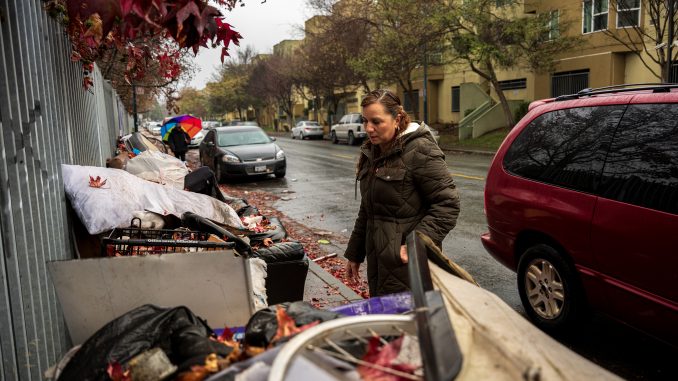
East Oakland residents living in illegal dumping hot spots share how their daily routines have changed to deal with trash.

This story was reported by El Tímpano, a civic media organization serving and covering the Bay Area’s Latino and Mayan immigrants.
Maria Suarez no longer visits her usual laundromat or walks a few blocks to local businesses due to the amount of trash she encounters on the streets around her home in East Oakland. Her surrounding neighborhoods, home to large Latino and Black populations, are littered with furniture, household items, clothes, and garbage that pile up in front of homes, businesses, parks, and schools, posing risks and challenges for residents.
“It’s not just what you see,” says Suarez. “It’s affecting people’s businesses, health, and families from the inside.”
Neighborhoods that are predominantly communities of color experience higher rates of illegal dumping. District 7, where Suarez lives, is the second most impacted district, according to the most recent data collected by Oakland Public Works (OPW), the department that is responsible for operating and maintaining the city’s infrastructure. In that district, which borders San Leandro, Latinos make up more than half of the residents. The most affected neighborhood is District 3, or West Oakland, where almost half of the residents are Black.
“It’s not just what you see. It’s affecting people’s businesses, health, and families from the inside.”
– Maria Suarez, East Oakland resident
Suarez, an immigrant from Mexico living in Oakland for 23 years, says the problem has worsened over the years, and her family’s well-being has been affected. Her youngest daughter is a special education teacher at a nearby school, and the trash outside her workplace causes her a lot of distress. Suarez says that her daughter has built up a lot of anger and feels helpless, especially when her students have to witness it. Her daughter has even expressed a desire for the family to move out of Oakland due to the situation.
“Sometimes it’s hard,” says Suarez. “This is not what you dream of because one sees that there are problems beyond your reach that you cannot solve.”
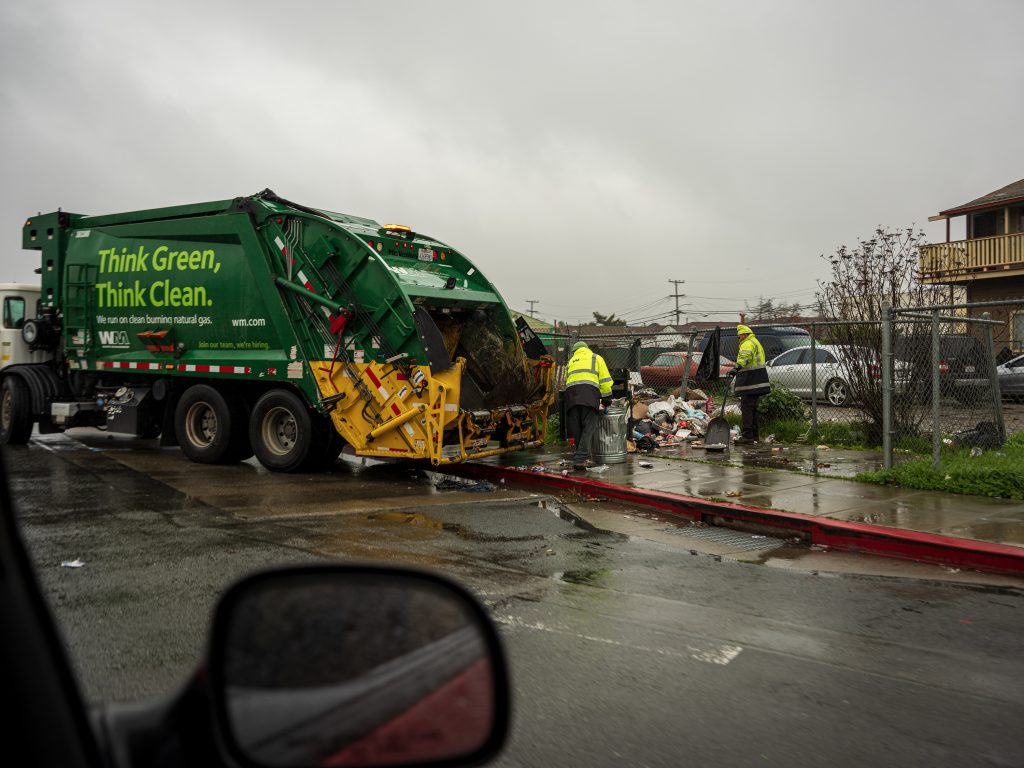
The city operates multiple programs to combat the problem, including hiring crews and services to pick up trash. The clean-up crews operate in four different zones that stretch from the Berkeley border to Lake Merritt, Lake Merritt to High Street, High Street to 82nd Avenue, and 82nd Avenue to the San Leandro border. The length of their stay in a specific zone depends upon how clean it is, ranging from two to five days.
Suarez is a community leader at Faith in Action East Bay, a faith-based nonprofit advocacy organization, that has been working to address the issue of illegal dumping in Oakland since 2015. Together with Block by Block Organizing Network, another nonprofit community organization, they organized virtual illegal dumping “research and accountability” meetings with each of the city council members in 2023 to demand action and greater accountability from city leaders on this issue.
During their last meeting with council members Nikki Fortunato Bas, Dan Kalb, Rebecca Kaplan, and Janani Ramachandran, in December, advocates from the two organizations demanded that Oaklanders’ taxes be put to work to clean the streets. They also asked council members to provide a report every three months on the progress that has been made towards illegal dumping.
Consuelo Cuevas, who has been an East Oakland resident for 25 years, says the cleaning efforts are not enough. “They clean, and the next day it is full [of garbage] again,” says Cuevas. “It’s not fair that we are paying our taxes, and you go to MacArthur on up, and all the streets are clean, and from MacArthur on down, there is filth,” she added.
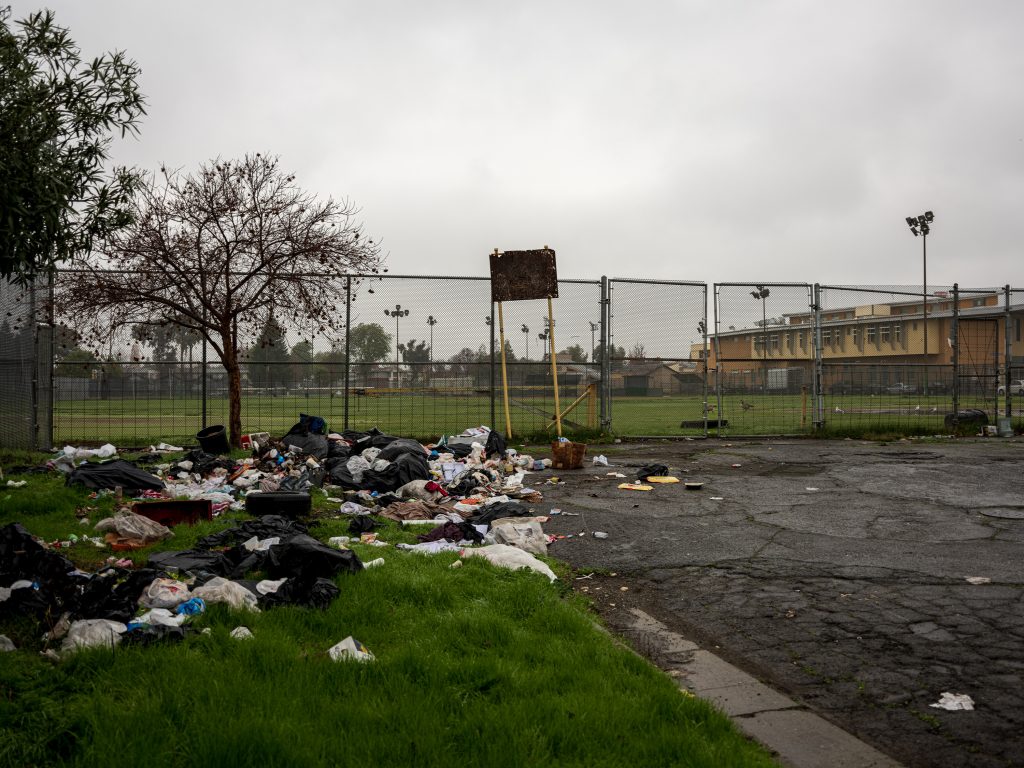
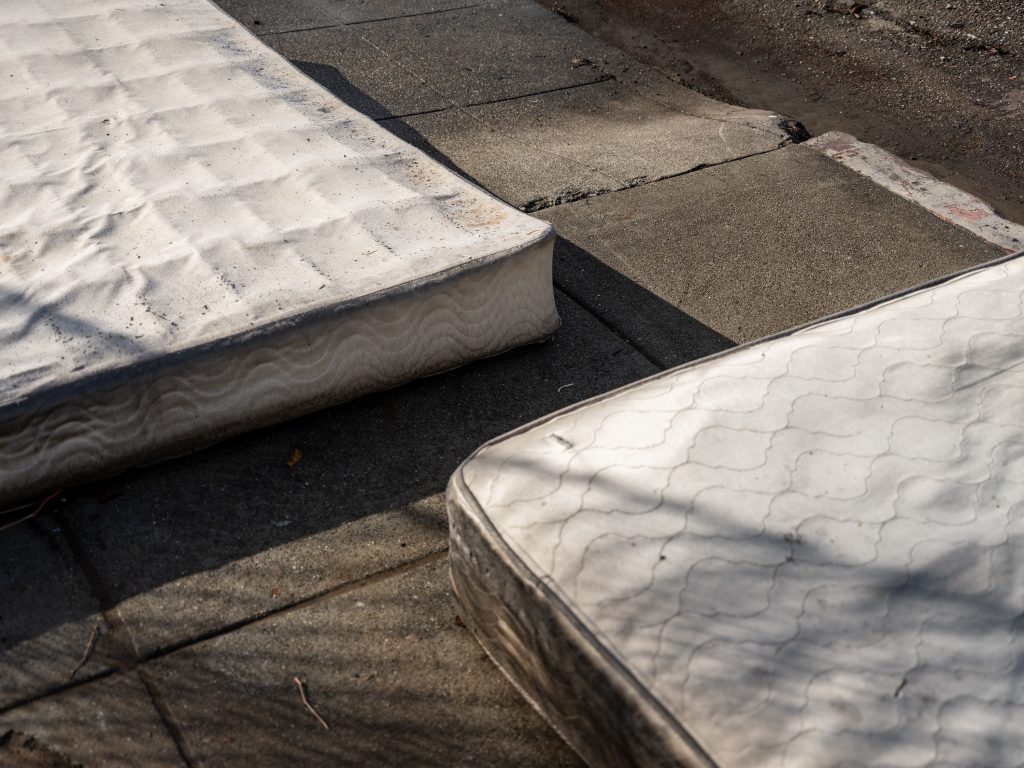
According to OPW, approximately 34 million pounds of trash were illegally dumped in Oakland during the 2021-2022 fiscal year.
“There is so much garbage that I have to get off the sidewalk and walk down the middle of the street, and sometimes cars almost hit me,” says Cuevas. “Sometimes, I have to walk through the trash to avoid getting off the sidewalk.”
Francisco Morales has lived in Oakland for 15 years and his Arroyo Viejo neighborhood in East Oakland has become a hotspot for illegal dumpers. “Right now, there is garbage that has been there for about a year,” says Morales. “People dump tires or bags of garbage, and when I can, I grab some of it and throw it in my trash bin when I have space.”
Morales, who doesn’t own a car, has been seeking help from his brother to dispose of the trash. He fills up his brother’s pick-up truck and takes it over to a garbage dump in San Leandro, which he says costs him around $65 each time he visits.
“It also attracts rats,” Morales added. “So, for me, it’s good to keep the area clean because sometimes they get into my home, but I have to spend my money to keep it clean.”
Morales says he reports the issue to his landlord, who then reports it to the city, but he says he’s never seen anyone from the city come out to clean up the trash around his home.
According to an emailed statement provided by OPW’s Director Harold Duffey, the city is expanding its illegal dumping unit to reach more streets. “The quantity of illegal dumping removed by OPW crews has increased significantly over the past five years and the problem continues to grow,” Duffey said. “In addition to being a nuisance, illegal dumping has significant economic, environmental, health, and safety impacts.”
Lack of Enforcement
In March 2022, the city launched the Illegal Dumping Camera Program, a surveillance initiative designed to catch illegal dumpers. From March 2022 to February 2023, the cameras captured nearly 500 incidents of illegal dumping from known hotspots, and a total of 72 citations were written in the nine-month period, according to an Annual Report on Surveillance by OPW. However, the Environmental Enforcement Unit staff could not discern license plate information for 55% of the illegal dumping incidents captured by the cameras, and the perpetrators could not be held accountable.
“Reduction and abatement alone cannot solve the problem as long as we have individuals and unlicensed haulers dumping illegally without consequences,” Duffey said, and added that the department would like to see license plate readers deployed in conjunction with security cameras.
Suarez says FIAB and BBBON will continue to meet with council members this year. “I am hopeful that in this fight we can achieve something,” she says. “That one day I’ll be able to return to the park that’s two blocks away – where I would take my girls to play – to walk and to see it clean again.”


Be the first to comment